Why Computer Literacy Matters

I just got this e-mail. I laughed.

Good day. You have received an eCard To pick up your eCard, choose from any of the following options: Click on the following link (or copy & paste it into your web browser): http://example.com/e-card.exe Your card will be aviailable for pick-up beginning for the next 30 days. Please be sure to view your eCard before the days are up! We hope you enjoy you eCard. Thank You!

An eCard from a domain I’ve never heard of, with a .exe attachment? I don’t think so. (Note that the actual domain wasn’t example.com, but I wanted to ensure that my blog post about a virus didn’t result in someone visiting it…)

But there are probably a lot of people who would have gotten that e-mail and merrily visited it to see their eCard, without thinking, “I shouldn’t visit links from strangers,” much less, “I shouldn’t visit links that end in .exe.”

Though presumably, at least some of the people who blindly followed it would catch on when trying to view their eCard prompted them to download a file. But I think this shows why user education is so important. To me, and probably to most readers here, it’s almost comically obvious that that link would be a virus. And yet, since they keep sending out e-mails like this, I have to think that they’re getting a decent number of people with them.

Absurdities

My Diet

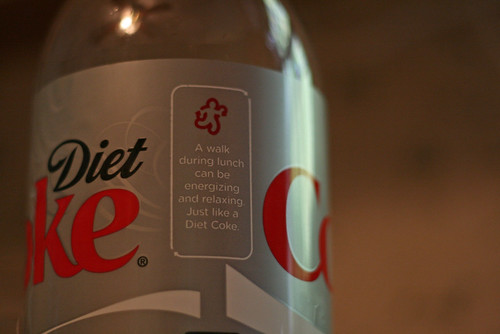
Some might say it’s weird to go on a walk during lunch, though I assume that they mean lunch break, as opposed to eating while walking. (Which, if it’s anything like jogging after eating, I highly recommend you not do. Trust me.)

But why bother? Just like going for a walk, sitting back and sipping a nice cold Diet Coke is also energizing and relaxing.

What am I doing to stay fit? I’m downing Diet Coke.

Bill Ayers

Palin’s been instructed to keep bringing up Obama’s ties to Bill Ayers, and the McCain campaign released a video on the web “exposing” them.

I think Obama put it well when Hillary tried to use it against him: “The notion that somehow as a consequence of me knowing somebody who engaged in detestable acts 40 years ago, when I was 8 years old, somehow reflects on me and my values, doesn’t make much sense.” And yet that’s exactly what John McCain’s strategy is.

How do they know each other? They served on the board of a charity to help failing schools in Chicago. Ayers, a domestic terrorist forty years ago, turned himself in and has since been a strong advocate for education. The articles I’ve read suggest that even conservatives have given him accolades for his work. (And as for the articles that came out, quite ironically, on September 10 and 11, 2001 about Ayers not regretting what he did? Well, if you believe Ayers (who, after all, had just the interview: it’s not like he had much of a reason to lie the next day?), that’s actually not what he said: he meant that he regretted that the war wasn’t stopped, not that he didn’t regret the violence.)

I can’t help but view these as desperate actions. McCain is trailing in the polls, probably because of a surge of interest in the economy, something McCain has admitted is a weak area of his. Ironically, in 1989, McCain would come under fire for “improperly intervening” in a bank collapse, ultimately costing the government $2 billion. Of course, that was almost 20 years ago, and no one’s really been bringing it up because, well, there’s much more important stuff to talk about.

Again, it’s no great secret that I’m pretty biased against McCain. But I can’t help but think that what he’s been doing lately drives home exactly why he shouldn’t be President: he’s corrupting the truth and attacking others to distract us from the issues that really matter to us. And after the past eight years, I think we’ve had enough of that.

Polls

I’m fond of the Electoral-Vote.com site; it’s run by an American expat with a Ph.D. in statistics, and a keen passion for following politics and polls. He’s slanted to the left, surely, but there’s nothing wrong with that. Err, I meant to say, he doesn’t let his political persuasions influence poll results.

I’ve just put a little graphic on the right corner of the main page, just below the table of contents, showing his most recent count. He’s not generating those graphics for every Senate race, but you can view a page of Senate poll results here. I have to wonder if the plummet in Shaheen’s poll numbers was the result of the massive conservative attacks accusing her of implementing sales and income taxes… Though I’m not sure what’s behind Sununu’s, when he fell to 35% in polls. It predated my blog post about him, so it can’t be that. 😉 What’s interesting about the Sununu-Shaheen Senate race, besides the number of capital S’s, is that, until about a month ago, Shaheen seemed a shoe-in. Now I’d dare say that all bets are off: she’s still ahead on average, but they’re close and it’s rocky.

North Carolina’s an interesting state, too. Their Senate race graph is weird, with incubment Republican Elizabeth Dole (in answer to the inevitable question, yes, she’s married to Bob) initially soaring some 15 points ahead of the Democratic contender, Kay Hagan. But Dole has slowly dropped in polls, until they were tied in August. And then the graph started taking some pretty wild drugs, and they’re now basically in a tie, surging and plummeting at the same time, which doesn’t make an awful lot of sense.

North Carolina is also the only state that “the Votemaster” is calling a tie right now, with John McCain enjoying a sizeable lead until mid-September, when things got close and intense. Now they’re pretty much tied; the regression lines since September show Obama gaining and McCain losing, but realistically, they’re tied, and staying tied.

It’s a certain battleground state, with a lot of electoral votes (15) and a close race. Florida, too, is awfully close with its 27 votes, but leaning towards Obama. (However, that shouldn’t mean a lot when it comes to Floridians going to the polls?). Ohio, with 20 votes, is also really close, leaning blue. Indiana has 11 votes, and is slightly leaning McCain‘s way; he seems to be gaining in polls there as well, though Obama’s still around 45%.

Texas, with its 34 electoral votes, is almost certainly for McCain, but what interests me is that, even in places like Texas, Obama’s got almost 45% of the vote. (And 40% in Kansas.)

Meanwhile, the NH House races look blue, too. An October poll has Shea-Porter at 50%, to Bradley’s 41%, and Hodes (District 2) towering over Jennifer Horn, 47% to 34%.

There doesn’t appear to be much polling going on for the the NH Legislature, so my curiousity about Sheila Roberge will persist…
Iran

It turns out that, right after 9/11, Iran was a big ally of the US. Let me say that again*: Iran rounded up hundreds of suspected al Qaeda members for us right after 9/11. They notifed the UN and us, and let us come in and interrogate them. And they “sought a broader relationship with the United States.”

But Bush just kept referring to them as the “axis of evil” and refused to work with them.

Iran has rapidly been becoming a menace. But how did they go from an ally looking to strengthen ties with us, to an enemy who hates us and is seeking to acquire nuclear weapons?

Why, exactly, is it a bad thing that Obama has said he’d be willing to meet with Iranian leaders? It sounds like it’s exactly what we need to do: not only might Iran still be willing to work with us, but the article goes on to talk about how a US-Iranian alliance could be useful in the area.

  • Thinly-veiled reference to Joe Biden fully intended.

Massachusetts Map

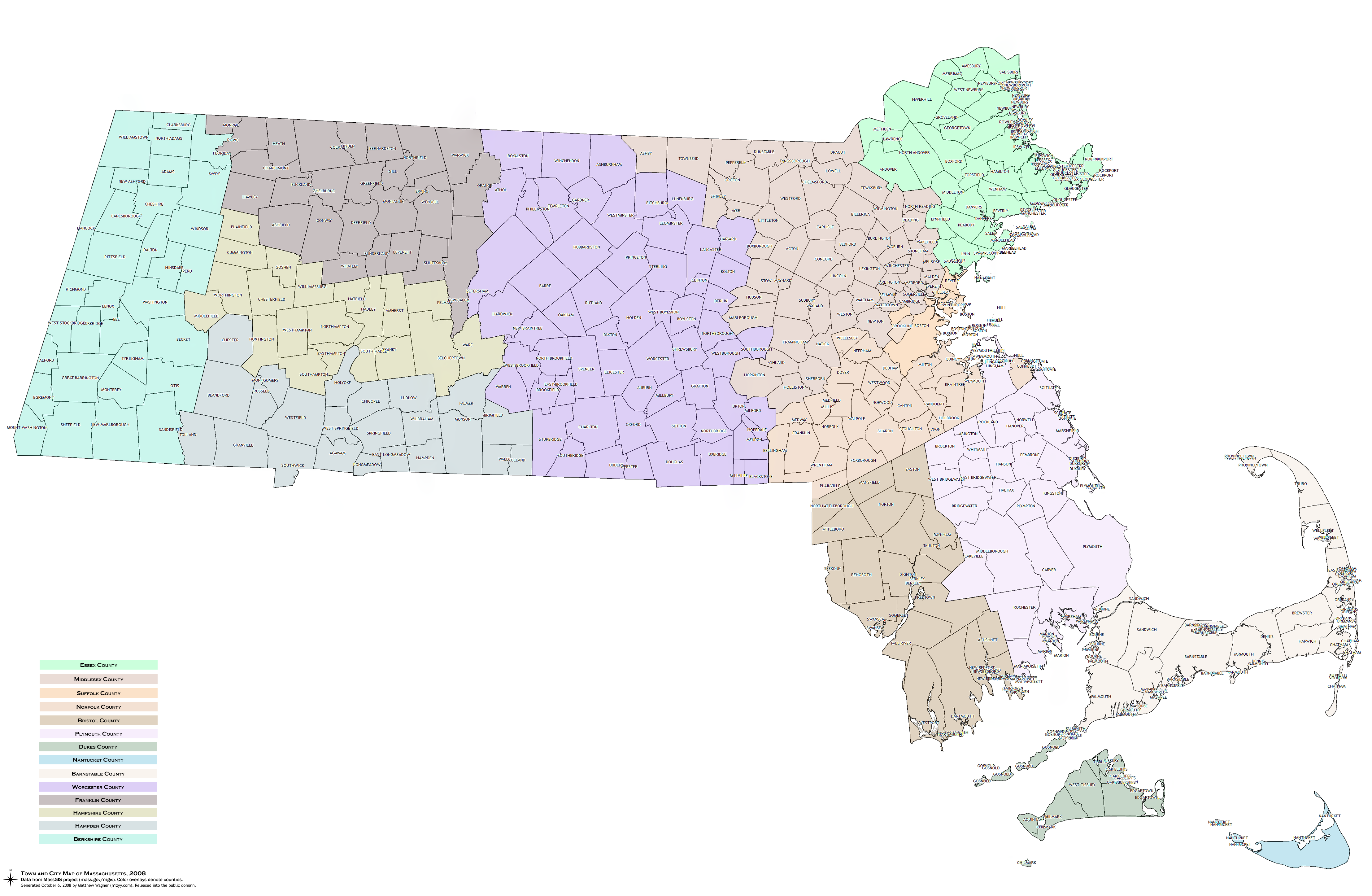
I was pretty annoyed that it seemed impossible to find a map that showed all the towns and cities in Massachusetts. Google Maps or the like don’t cut it for what I was looking for: just the town ‘political boundaries.’ It turns out that Massachusetts has a sizeable GIS repository, appropriately named MassGIS. So I grabbed a couple map sets and used QGIS to make my own map. It doesn’t provide an “Export as PNG” option, so I panned around, saving them as images, and then used Windows Live Photo Gallery to assemble them as a ‘panorama.’ (I was going to use Photoshop, but there was no need!) I let QGIS color the map based on county, though with the data MassGIS provides, I could have just as easily done it based on the population, number of schools, number of police officers, number of lakes, or a *lot *of other variables. At 4431×2893 pixels, it’s “only” 2.26 MB as a PNG. Since all I really did was stitch a couple GIS datasets together and check a few options in QGIS, I’m releasing this map into the public domain. Enjoy!

A giant map of Massachusetts towns

The Bailout

Now that the $700 billion bailout has passed

Did you know that it was initially the “Paul Wellstone and Pete Domenici Mental Health Parity and Addiction Equity Act of 2008,” and was introducedon March 9, 2007?

The name was later updated, to the “A bill to provide authority for the Federal Government to purchase and insure certain types of troubled assets for the purposes of providing stability to and preventing disruption in the economy and financial system and protecting taxpayers, to amend the Internal Revenue Code of 1986 to provide incentives for energy production and conservation, to extend certain expiring provisions, to provide individual income tax relief, and for other purposes.”

That’s the title. Someone failed literature class, I think.

In Theory

A few months ago, I was listening to some sort of talk radio, and they were discussing Cuba’s economy, which was very slowly introducing a few little bits of capitalism, albeit heavily-regulated capitalism. And they managed to get an interview with Fidel Castro’s daughter (I think?), who talked pretty eloquently about the economy. She seemed much more progressive than her father or uncle, albeit still in favor of Cuban Socialism.

The interviewer seemed to try to trick her into admitting that socialism was flawed. And her answer (paraphrased) is the subject of this blog post:

“Of course it’s imperfect. While I believe socialism is perfect in theory, it’s very hard to put that theory into motion accurately. So we’re continually fine-tuning our implementation of it.”

While I’m sure it’s debateable whether socialism is a sound theory or not, the reasoning struck me as interesting. And it so accurately applies to a few other topics.

  • School vouchers. I used to be a gung-ho fan of them. What’s better than bringing the power–if not the magic–of the free market to the school system? But in practice, it seems that, time and time again, school voucher programs have led to the good students getting out of failing schools, leaving the failing schools, and most of the students, even worse off. So vouchers are a great idea, in theory. But at least so far, the implementations of it seem to work about as well as Cuban Socialism.
  • Tasers for cops. They’re meant as a non-lethal alternative, after most other means of force have been exhausted. As a conflict escalates, the police are justified in using more and more force to try to stop it. And tasers are supposed to come right before “baton to the skull” or “strangulation” on that scale of force. In that case, they’re quire effective, saving lives and preventing permanent injury. In practice, they’re consistently misused.
  • Content filters in schools and libraries. It’s far too easy to bump into porn when you’re not looking for it. Ensuring that young children doing research don’t accidentally end up at hard-core porn sites is a good thing. In practice, content filters seem to block myriad legitimate sites and get in the way of legitimate research.

I’m sure the concept applies to ten thousand other things, too, but these are off the top of my head. But I think “a perfect idea–in theory” is a pretty useful concept to have in mind in describing ideas.

Memory Fragmentation

Here’s a question for the people here who are more of a computer whiz than I am: is fragmentation of objects in memory really a big deal? Both the MySQL query cache and the APC cache become fragmented over time, as various objects get cached and then purged.

Does this really make a big difference? You see a huge rise in access times when it happens on disk, but in RAM? Or will the applications require a contiguous allocation and thus just not use it at all? (And, for bonus points, why has no one written a ‘memory defragmenter’ if such a thing exists? Given that my needs are for managing small chunks of memory, there’s no reason, actually, that it couldn’t simply reconstitute the 16MB cache in a wholly separate, contiguous chunk of RAM?

Why Sununu Doesn’t Have My Vote

As many are probably aware, 2008 will also see plenty of House and Senate seats up for grabs, along with NH’s governor position. Even though I’m currently a registered Democrat and tend to be pretty liberal, I like to think of myself as a bit of a centrist, and I can’t bring myself to vote party line without considering both sides. Voting is just too important to play party favorites: every now and then I think the Republicans field the better candidate. In particular, I was concerned because conservatives seem to be adamantly opposed to Jeanne Shaheen’s run for Senate. She’s gunning for Sununu’s seat. There are a few Democrats that frankly scare me: there are rumblings about some Democrats trying to implement a sales tax in NH, for example, and some Democrats who really buy the stereotype that Democrats go out of their way to run up taxes and spend out of control. So I looked carefully at both candidates, wondering who the better candidate was.

Suffice it to say, Shaheen’s got my vote. From his page at OnTheIssues, here are some of the reasons I can’t bring myself to give Sununu my vote. The text is copied-and-pasted from that page, but any links are my own doing, as are any bracketed comments. Emphasis is mine: bold to highlight things I think are exceptionally important, italics to highlight things that might be unclear (like ‘double negative’ bills: voting NO on disallowing something).

  • Voted NO on $100M to reduce teen pregnancy by education & contraceptives. (Mar 2005)
  • Voted YES on recommending Constitutional ban on flag desecration. (Jun 2006)
  • Rated 13% by the ACLU, indicating an anti-civil rights voting record. (Dec 2002)
  • Rated 33% by the HRC, indicating a mixed record on gay rights. (Dec 2006)
  • Voted NO on repealing tax subsidy for companies which move US jobs offshore. (Mar 2005)
  • Voted NO on reinstating $1.15 billion funding for the COPS Program. (Mar 2007)
  • Voted YES on prohibiting needle exchange & medical marijuana in DC. (Oct 1999) [While I don’t understand the opposition to medical marijuana, I’ll let that go. But needle exchanges have been extremely good at preventing the spread of disease.]
  • Voted NO on shifting $11B from corporate tax loopholes to education. (Mar 2005)
  • Voted YES on allowing school prayer during the War on Terror. (Nov 2001) [I actually don’t know much about this: “allowing school prayer” is a pet peeve of mine, because allowing kids to pray is Constitutionally required, but allowing public schools to hold prayer sessions is Constitutionally prohibited. I’m assuming it was the latter, since there’s no reason to pass a law  to “allow” kids to say a prayer on their own: it’d be like passing a law saying that freedom of speech is allowed.]
  • Supports requiring schools to allow prayer. (Jan 2001) [Ibid]
  • Rated 27% by the NEA, indicating anti-public education votes. (Dec 2003)
  • Voted NO on making oil-producing and exporting cartels illegal. (Jun 2007)
  • Voted NO on disallowing an oil leasing program in Alaska’s ANWR. (Nov 2005)
  • Voted NO on $3.1B for emergency oil assistance for hurricane-hit areas. (Oct 2005)
  • Voted NO on banning drilling in the Arctic National Wildlife Refuge. (Mar 2005)
  • Voted NO on raising CAFE standards; incentives for alternative fuels. (Aug 2001)
  • Rated 100% by the Christian Coalition: a pro-family voting record. (Dec 2003)
  • Voted NO on granting the District of Columbia a seat in Congress. (Sep 2007)
  • Voted YES on allowing some lobbyist gifts to Congress. (Mar 2006)
  • Voted NO on establishing the Senate Office of Public Integrity. (Mar 2006)
  • Voted NO on requiring FISA court warrant to monitor US-to-foreign calls. (Feb 2008)
  • Voted NO on implementing the 9/11 Commission report. (Mar 2007)
  • Voted NO on restricting business with entities linked to terrorism. (Jul 2005)
  • Voted NO on restricting employer interference in union organizing. (Jun 2007)
  • Rated 0% by the AFL-CIO, indicating an anti-union voting record. (Dec 2003) [I’m not the biggest advocate of unions out there, but Sununu seems a little too anti-union.]
  • Voted NO on investigating contract awards in Iraq & Afghanistan. (Nov 2005)

There’s probably more, too, but I thought this was sufficient grounds to cast my vote for Shaheen.