John McCain

Perhaps the Times of London puts it best, in saying that a “desperate McCain” has been stepping up personal attacks on Obama.

Sarah Palin has been lambasting Obama‘s ties to domestic terrorists. Obama and Bill Ayers “worked with a non-profit group trying to raise funds for a school improvement project and a charitable foundation” in the 90’s. Ayers was formerly involved in the Weatherman. (Actually, he was a cofounder.)

Referring to Ayers, Obama has called him, “somebody who engaged in detestable acts 40 years ago, when I was 8.” And a decade ago they worked together on a school-improvement charity. Associating with terrorists? Just like his lobbying to teach sex-ed to kindergartners, which actually amounted to a plan to teach kindergartners about avoiding sexual predators.

Please, McCain, we’re not that dumb. Your repeated lies not only confirm the Democrats’ cries that McCain would just be a third Bush term, but they also make you look weak. Is there nothing truthful you can use to your advantage? Please, let’s stick with honesty this election.

American Chestnuts

American Chestnut Leaf
I realized a while ago that my knowledge of nature was woefully inadequate. Maple tree? Oak tree? Pine tree? There’s a difference? So I’ve been working on looking up various things, and when I can’t find an answer, posting photos of plants on Flickr to be identified.

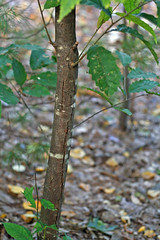
The leaves pictured at left seem to be those of the American Chestnut. It turns out that the American Chestnut is fairly rare. It’s apparently common for them to grow to about ten feet, until the trunk is an inch or two in diameter. And then…

American Chestnut Blight

Chestnut Blight strikes. (See photo on right.) It seems that the fungus was accidentally introduced to America in 1904 on Asian Chestnut trees, which were mostly resistant to the blight. American Chestnuts were not, and are not. They were pretty much totally wiped out. The trees aren’t affected until they’re somewhat large, but pretty routinely die before they’re able to drop seeds. As I understand it, there are viruses that attack the blight’s fungus, which can slow the blight enough for the tree to recover. The virus is chyphonectria parasitica. As I understand it, it is also common to inject trees with weakened strains of the blight, allowing them to recover. (Somewhat like a flu shot?)

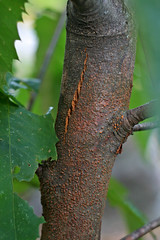
Blighted American Chestnut
Over time the blight will cause multiple ‘cankers’ in the tree, and create reddish-orange spores. And inevitably, the American Chestnut dies. New growth from the base is common, sometimes growing five to ten feet tall, but almost never mature enough to reproduce.

So I’ve become somewhat obsessive about this, trying to figure out what can be done to stop the blight to allow these trees to grow. Given that it’s a problem confounding lots of arborists, I have a hunch that the first idea that popped into my mind (spraying bleach on the blighted areas) may be less than ideal.

But I thought I’d share today’s trivial pursuit and useless knowledge with you.

Repetition

There’s an old saying, that if you repeat a lie often enough, it becomes true.

Watching Governor Palin last night, after previously watching John McCain, I realized how true this is.

  • Obama voted against funding the war in Iraq. So did John McCain! As I’ve seen it, there were multiple bills at one point. One had a timeline, which John McCain voted against. One didn’t, which Obama voted against. But John McCain and Sarah Palin keep harping on this, because it sounds awful. But John McCain did the same thing.
  • Obama wants to raise taxes. On those making over $250,000 a year, sure. But a cornerstone of Obama’s plan is that he’s not going to raise taxes on anyone making less, coupled with tax cuts for the middle class. He describes it in great detail on his site. As part of a middle-class family making under $250,000 a year, we will do better under Obama’s plan than under John McCain’s. But it’s been said so often that Obama wants to raise taxes that it sounds true. It’s not.
  • Obama voted to raise taxes on those making $40,000 or more. No, that wasn’t a vote on taxes. And John McCain voted the same way. It was a vote on budget appropriations, not taxes.
  • Obama wants to surrender in Iraq. Obama has proposed the same thing that the Iraqi government and George Bush have proposed! A phased withdrawal so we can shift our focus to Afghanistan. (You know, the place with Osama bin Laden.)
  • Obama voted 97 times to raise taxes. And care to guess how many times McCain voted to raise taxes? We’re in a war that’s already cost us more than half a trillion dollars, and there’s a proposed $700 billion bailout proposal on the table. When spending increases, you have to raise taxes. Biden put the number of times McCain has voted to raise taxes as many times higher than Obama’s…

It just drives me crazy to see all of these mistruths repeated over and over again. There really ought to be a rule that you have to tell the truth in debates, and that you have to actually answer the questions asked.

$700 Billion

So I’ll admit that I don’t know the whole deal with the economic bailout proposal. But I’d like to make a number of points about it:

  • No one I’ve talked to really understands the whole deal. I’d really like to see a poll of ordinary Americans that asks them to explain (or choose, via multiple-choice) the issue.
  • I think it’s a failing of Congress in general that no one has explained this clearly. Why didn’t President Bush’s speech explain it? Why haven’t Obama and McCain done so?
  • The proposal was $700 billion. The CIA puts our population at 303,824,640 people. That’s $2,303.96 per person. While it wouldn’t directly solve the bank crises, this could be quite an “economic stimulus package.” Imagine a check for $9,215 being mailed to my family. (A family of four, times the $2303.96.) High gas prices? People in danger of losing their homes? Consumer spending down? Giving every American a few thousand dollars would help a lot.

Of course, this is a bit misleading, since the real issue is the banks failing. And you could make a good case that “giving” taxpayers money is somewhat ridiculous, since we’d essentially pay $2,303.96 more in taxes and then have it mailed back to us. But still, I think it’s interesting food for thought…

Heh

Today’s little bit of “Now that I think about it, that makes sense…” wisdom: if your system happens to be a recursing nameserver, when running something to display open network connections, don’t let it resolve hostnames… Caching keeps it from becoming an infinite loop, but you will end up opening a new network connection for every nameserver in the chain… And each of those requires a DNS lookup…

Wikipedia Geek

I noticed Wikipedia was extraordinarily slow.

Instead of being normal and thinking, “Huh, I can’t reach Wikipedia,” I decided to investigate. One neat thing about Wikipedia is that it’s very open: not just in the sense than anyone can edit Wikipedia or that Mediawiki is open-source, but that you can view their Ganglia monitoring system and even an (off-site) server admin log, which in this case reveals the problem. (Reversing the order of entries so that it’s chronological):

# 14:00 RobH: updated redirects.conf and pushed change for orphaned domains. # 14:01 RobH: Site is down, go me =[ # 14:06 RobH: Pushed out old redirects.conf and restarted apaches. # 14:10 RobH: Site back up, slow as squids play catchup.

So there you have it. A broken configuration file got released, breaking all the backend Apache webservers. It was fixed, but seems that the cache is still being rebuilt, so it might be slow for a while. In the meantime, why not read up on the Wikipedia server cluster? Or some graphs? For example, the daily bandwidth usage: pmtpa is their Tampa, FL colocation facility (serving the US) and knams is in the Netherlands (I think). (yaseo, the yellow one on the legend with no data, is a Yahoo data center in Korea.) You can see that the US cluster is hitting 3 Gbps, while the Europe cluster is exceeding 5 Gbps (!).

In any case, Wikipedia’s back up now. 😛

Blacklists

I don’t put a lot of faith in DNSBLs, which are blacklists of spammer IPs. (They’re hosted as nameserver entries; you’d submit a DNS lookup for 4.3.2.1.example.com, where example.com was the DNSBL, to see if 1.2.3.4 was in the list; if it was, you’d get an “A” record of 127.0.0.2 (customary) back as a match.)

My concern is mostly that, historically, DNSBL providers have gotten carried away and started to list whole netblocks, and then whole netblocks of their enemies who aren’t sending spam… And pretty soon, you’re getting a lot of false positives. (Non-spammers who falsely test “positive” in spam checks.) In other words, you start rejecting legitimate e-mail because the blacklists tell you it’s spam. That’s a risk I’m not willing to take, and it’s an even more unacceptable risk for a business to take.

Other blacklists just don’t work. They match something like 10% of spammers. One blacklist I looked at rejects something like 40% of spam, and 50% of legitimate mail. (Yes, that’s right: it rejects more legitimate mail than spam.) So you probably won’t be surprised to learn that I don’t use any blacklists, other than a running list of people who have sent me obvious spam in the past 14 days. (I should probably lower the time period to something like 5 days, but I’m really not in a hurry to.)

But there are some blacklists that aren’t evil. Take these stats with a grain of salt, because they don’t check for false positives, and because they’re based on a limited sample, but I’ve found the following lists to be reliable:

  • zen.spamhaus.org: 100.00% matches, 101.77 ms. average response time. This merges all the Spamhaus zones, which include not only a list of known, persistent spammers, but also a list of exploited machines, and their “Policy Blacklist,” of things like cable modem netblocks.
  • t1.dnsbl.net.au: 100.00% matches, 260.61 ms. average response time. This is also an aggregate zone of an Australian DNSBL provider, with very good results.
  • karmasphere.email-sender.dnsbl.karmasphere.com: 100.00% matches, 96.31 ms. average response time.
  • hostkarma.junkemailfilter.com: 85.71% matches, 552.92 ms. average response time. It’s very slow to load for me, for some reason, but it has good results.
  • psbl.surriel.com: 50.00% matches, 394.72 ms. average response time. An automated blacklist based on Spamikaze. Incidentally, Spakikaze reports some other blacklists using their code, which I might want to evaluate, too.
  • ubl.unsubscore.com: 42.86% matches, 52.75 ms. average response time. A bit about the list is published on the excellent OpenRBL Wiki. Even though it comes after a list of DNSBLs with “100%” matches, 42.86% is actually very good in the real world.

Between the OpenRBL site and Spamikaze’s list, I do have some more that I’d like to experiment with. I should again reiterate that this was a very non-scientific test; it evaluated fewer than 20 IP addresses which have been blacklisted by my servers in the past few days. It assumes that their servers get spam from the same sources that I do; given that many large blacklists contain millions of IPs, this isn’t an accurate assumption at all. All these statistics are really good for is pointing out blacklists that are worth taking a look at.