YDA Conference

This weekend was the Youth Democrats of America conference in Manchester, NH. I’d toyed for months with renting a fast telephoto for the event. In hindsight, I’m glad I didn’t—most of the speakers I wanted to capture weren’t even there.
title=”IMG_1785 by n1zyy, on Flickr”>IMG_1785

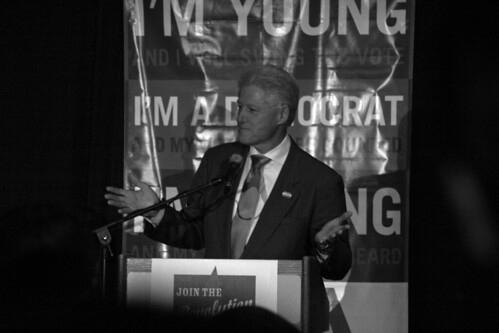
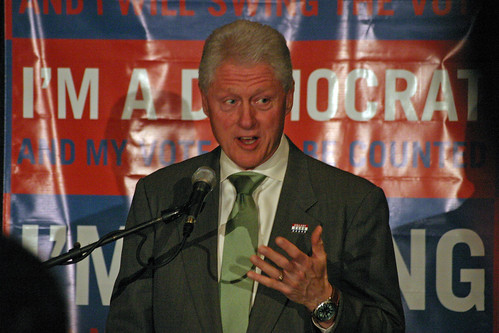
Bill Clinton was the first speaker. He delivered an amazing speech, but also kicked off what would rapidly become an irritating trend—unabashed praise of Hillary. Right before Hillary was the state chair of something (Youth Democrats?), who explained that he was prohibited from endorsing a candidate. So his speech began, “Effective Monday, I resign from my post. I’m going to join the Hillary campaign.” It seemed pretty inappropriate.

Clinton, though, was a great speaker, and it’s understandable that he’d back Hillary. He talked about how excited the debates last week made him—the Democrats weren’t debating whether global warming was a myth, or whether health care was broken. They were debating the best way to fix it. I wish I had a better recall of the exact figures, but he mentioned that the US pays something like $700 billion a year more than any other nation on healthcare. He said that if we were to close our eyes, pick a country, and copy their health care system, we’d end up saving a lot of money. So he complained about the people that whine about “socialized medicine”—even if we went with a truly Socialist plan, it would save us money. But no one proposed that we become Socialists anyway.

The next morning we had a series of luncheon speakers. Most of them were pretty bad. The first one stood up there before it started pleading with us to hurry up. Like, probably every 90 seconds he’d make an announcement, alternating between asking us to get food and asking us to get food quickly and reminding us that there were two separate lines. And he’d add in “funny” comments like, “If the person in front of you is taking too long, shove them,” which really didn’t do anything but grate on our nerves. And then we had a series of speakers that no one knew that really weren’t that good. One of them I think was taking some serious drugs or something. He started of by talking about going “back to the future,” and all sorts of other things, and never really tied any of them together. And there was this joke that none of us even understood about Bush getting off an airplane carrying two pigs, but he started it off by pretending it was an actual news story. We were talking about it afterwards, and basically all admitted that we had either laughed because everyone else was and we didn’t want to seem like we got it, or, for a few people, they laughed just out of sympathy because he’d taken so long setting up for it and yet it came out making no sense.
title=”Elizabeth Edwards by n1zyy, on Flickr”>Elizabeth Edwards

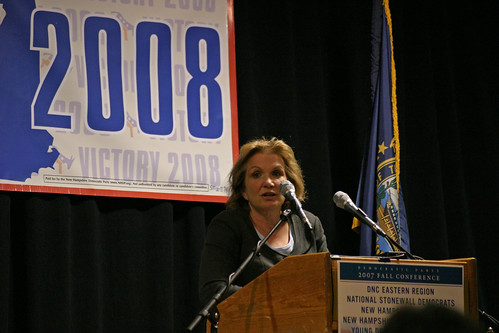
They served this big elaborate lunch, but only had coffee and water. So a few of us go find a vending machine. And I guess Elizabeth Edwards was just standing outside waiting until she was called as the next speaker, so they were able to just go talk to her. “And she talked back!” they said with some surprise. They came back and told us, so a few more of us went to see her, but she was going in right as we were coming out. So instead we went to find the vending machine. After checking a bunch of likely places, I asked at the front desk. “They’re on every odd floor—so 3, 5, 7, 9, and 11,” she told me. (One might assume that the lobby is an odd floor, but it’s called “Lobby,” followed by “Mezzanine” above, and then 3. So we took the elevator up to the third floor, bought a can of Dr [sic] Pepper for $1, and went back, by which time Elizabeth Edwards was speaking.

She delivered a really good speech about Edwards. I was very impressed, and when she turned it over to questions, the first question summed it up well: “Why aren’t you running for office?” The question drew a lot of applause. She’d make an amazing First Lady, because she really knows her stuff! And then a woman asked, “My partner and I have been together for 30 years. When I say that we want to be married, how would your husband—and how would you—answer us?” (Edwards has stood out as the Democrat most opposed to same-sex marriage.)

Her answer again drew applause, when she started off with, “Well, those are two separate questions.” Her answer was actually even more impressive, as she began talking about how it’s an “evolving issue” and that she hopes John’s stance would change with time. (Now you see why people wanted her to run?)

Someone else asked for her opinion on some obscure personal attack on a politician. Her answer was basically that she thinks it’s very important that the American people grill candidates with questions, but that sometimes people don’t respect people’s personal lives. She gave the example of people obsessed with Romney’s Mormonism, and then, “And some people criticized John for continuing in spite of my illness… I think that’s inappropriate.” (Again, applause.)

The rest of that day was going to be some sort of canvassing event that none of us wanted to go to. So we instead took the time to tour the local campaign headquarters of the candidates. We were given some really vague directions, and people kept expecting me to know all the backroads around Manchester. One direction involved turning at a prison, which somehow got misinterpreted. We pulled into a prison parking lot, and everyone was walking in. I pointed this out, but they insisted that his headquarters were inside. “No, there is no way that Obama has set up his headquarters inside a prison,” I argued. Someone else suggested, “Well, as long as we’re here, let’s just go inside and check.” I finally persuaded them that it would be incredibly embarrassing to walk into a prison and ask if Obama’s headquarters were there. (Actually, it would probably get interpreted as some sort of racist joke, as opposed to sheer idiocy?)

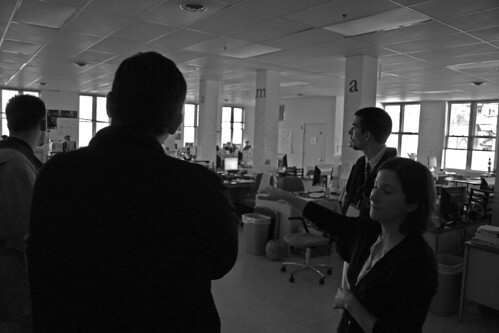
So we continued down the road, and not a half mile later, we were at the Obama headquarters. It was actually in the middle of nowhere, but the place was huge:
title=”Obama’s Offices by n1zyy, on Flickr”>Obama's Offices

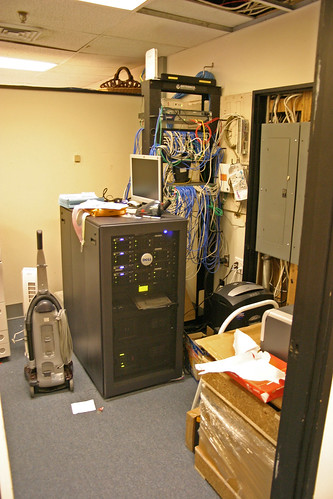
That just shows a small part of the office. It was substantially larger. Hillary’s offices weren’t as nice inside, though they were in a very plush office complex. But she wins points for largest IT infrastructure:
title=”Hillary’s Server Room by n1zyy, on Flickr”>Hillary's Server Room

N.B. that this server closet just powers this one little branch of Hillary’s many campaign offices.

At both places, the staff was more than happy to take a few minutes to show us around and talk about why they were supporting their candidate. I was really struck that all these volunteers seemed so professional.

And then we went to the Kucinich headquarters. I didn’t take any pictures inside, because it was a small place and would have been awkward. In hindsight, I really, really wish I had.
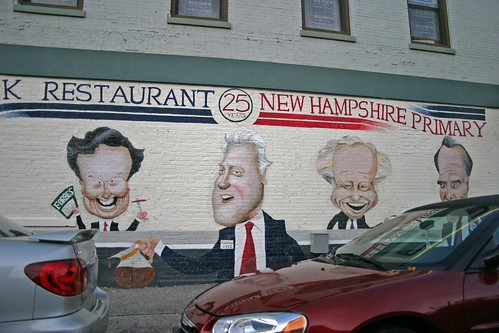
title=”Restaurant by n1zyy, on Flickr”>Restaurant

It was above this big restaurant, though, with an obvious political history. Inside we found a couple surprised volunteers. “We were in the middle of something,” one of them said, as the other jokingly added, “Inauguration planning.” “But we can talk to you for a couple minutes.” We thought it was pretty strange. One of them moved and a lighter fell out of his pocket. They both seemed pretty… mellow… as they talked to us, and were really all of the place in topics. They actually raised some good points, but the whole thing was really pretty creepy and left me liking Kucinich even less. (The quizzes I’ve taken say he’s my best match, but there’s more than just his stance on the issues that matters. If I were running for President, for example, and saw a UFO one night at home, I might think, “Gee, I’d probably look pretty crazy if I brought that up” and not mention it.) They ended up talking to us at length. At one point someone else came in, seemed surprised anyone was there, and went through these tiny little doors into some sort of oversized closet in the back room. It was amusingly creepy.

After we left, we started talking about how weird the whole thing had been. Someone asked, “Was I the only one that thought it smelled like weed?” Someone else agreed, and then we discussed them dropping a lighter, and how vague the “Oh, we were doing something, but I guess we can talk to you” thing was. And the sketchy back room.

This is not how you should be running a campaign? At all?

We ended up being pretty unimpressed with the YDA Conference, though. We had a good time and got lots done, but some of the best parts were when we skipped the official parts of it and did stuff on our own. We were initially told there’d be “Presidential speakers,” which we naively took to mean that the candidates would be there. Bill Clinton was the big one, followed by Elizabeth Edwards. Kucinich was supposed to be there but canceled. (Don’t worry, plenty of jokes about him, UFOs, and green leafy substances consumed in the back room of campaign offices have already been made to explain his absence.) Obama was never scheduled to come, it turns out, and his “speaker” was his half sister. We were going to go, but it was actually a “party” in the back room of some pub that was very overcrowded. So we left. We ended up not even sticking around today, after seeing the only interesting event of the day (Kucinich) had been canceled.

ISO: The Next Frontier?

In photography, there are a few key variables in determining exposure. The first is the aperture of the lens: basically, how much light is let in. Really serious (or rich) photographers carry around very “fast” lenses–they’re enormous and let in a ton of light. Notice the huge lenses that you see on the sidelines as sporting events, for example. (Err, not the length, but the width–these things are huge in both dimensions.) Of course, these lenses (we call them “fast” lenses, or lenses with wide apertures) are very heavy, and insanely expensive: for a really good one, you’d pay at least $1,000, and that’s pocket change compared to some lenses.

Another control is ISO sensitivity. Back in the days of film, some film was more sensitive to light than others. For example, ISO100 produces great pictures, but requires a lot of light. It’s superb for outdoor pictures on a sunny day. On the other hand, if you’re getting shots indoors, you might be at something like ISO1600. The problem is that, as you increase the sensitivity, you also increase the noise. ISO1600 will get decent shots indoors, but they’ll be grainy. (This is especially bad if you’re like me and tend to try to boost details in the shadows in Photoshop.)

The two come together to control the third important variable, shutter speed. In some cases, it doesn’t matter a ton. If it’s bright and sunny, and I’m taking a picture of a building, I really couldn’t care whether it’s 1/100th of a second or 1/4,000th of a second. And, if I’m using a tripod, it’s not uncommon to have shutter speeds lasting several seconds. But the problem is that, if the shutter speed is too low, you get a lot of blur. There are two reasons–the first is that people rarely hold still. I use 1/60 as a general rule of thumb: below that and you risk some blur if people are moving a lot. This is a really rough guess: I’ve gotten great portraits at 1/8, and sometimes 1/125 isn’t fast enough.

The bigger consideration, though, is camera shake, especially with longer zoom lenses. The rule of thumb there is 1/length. For example, shooting with a telephoto 200mm lens, it’s recommended that I shoot a 1/200 of a second or faster.

Putting it all into practice… Bill Clinton was speaking tonight at an event we went to. I have a 55-200mm telephoto lens, and tended to stay right around 200mm. I stayed at ISO1600; I can go to ISO3200 but it’s very grainy so I don’t use it. Unfortunately, though, my lens can’t go wider than f/5.6 at that length, which meant that the fastest I could get shots was around 1/60th of a second. At 200mm, this really was inadequate: most of the shots came out okay because I have a steady hand, but they’re not all that sharp. Example:

title=”IMG_1795 by n1zyy, on Flickr”>IMG_1795

It’s okay, but now compare it to this picture:

title=”Autumn Colors by n1zyy, on Flickr”>Autumn Colors

Granted, the subject isn’t that interesting, but every time I see that shot I took, I think, “Wow, that’s sharp!” Not so for the Clinton photo. If you view it in larger detail (click on it), its subtle blur becomes increasingly obvious.

There was a professional photographer about ten feet away from me. She was shooting a 70-200mm lens, which is a similar length to mine. But hers is an f/2.8 lens, which lets in twice as much light as mine does. So while I was getting 1/60 shutter speeds, she could have been getting 1/120. (Hers had Image Stabilization, too, but that’s a story for another day.)

The thing is, taking telephoto portraits indoors isn’t all that rare of a thing to do. To get good shots, you need to get that shutter speed up. There are two ways to do it, as you should now know: raise ISO or get a better lens. The problem is that getting a better lens will set me back $5,000 or so. And it’s an insanely heavy lens as well.

The other option is one that, until recently, wasn’t feasible: raise ISO some more. ISO1600 is good. You can do ISO3200, but it’s decent on only a few cameras. But I really have to give Nikon credit with their D3. It’ll go to ISO25600. Check out some samples. I’ve seen some higher-res images at ISO6400, and it’s just about perfect! Its ISO6400 rivals my ISO1600. The thing is, that’s a huge increase to be able to shoot at 6400 and have a perfectly usable image. It would have helped a lot with getting better shots.

I truly hope this is the direction camera makers go in now, and that Canon and Nikon get into an “ISO war” trying to outdo each other.

Jobs

I graduate in May. Here are some jobs that I’d like:

  • Doing soundtracks for movies. Not composing music, just spotting ideal music for songs. I have a whole playlist of songs that are crying out to be part of the soundtrack to a movie. I even resisted the urge to put every Moby song I own into the list. Also, Radiohead’s “Motion Picture Soundtrack” isn’t on the list.
  • Sports photographer. I’d like to go a Sox game some time, and I love taking pictures of things. So I’d basically be getting paid to do something I’d do anyway. And they’d provide me with the equipment. (I hope… Good lenses don’t come cheap.) Maybe just a photojournalist. I already have the press pass. 😉
  • Corporate CEO. It’s unclear where to submit my resume for this position. Maybe they’ll come to me when I get my degree?
  • Doing the soundtrack for Guitar Hero IV or whatever. I already have a list of songs that would be good.
  • President of the United States. No one’s political ideology is as closely aligned with my own as mine. I
  • President of my college. $750K/year. I’ve never even seen ours. I’d do it for half the pay and be twice as visible. And I’d fix the things that need fixing.
  • Police chief on-campus. We’re not solving an awful lot of crimes.

If I Controlled the News…

Things I care 0% about:

  • Norman Miller: No offense to his fans, but I’ve never even heard of him. It’s sad that another human is dead, sure, but if we don’t care when the 997th child of the day dies from malaria, why do we care that Normal Miller died?
  • The TV guild strikes. I don’t watch much TV. The Daily Show is funny… But if Jon Stewart is really funny, he should write his own stuff. Same for The Office. I can just not watch the TV shows. I usually don’t anyway.
  • The Harry Potter lexicon (?) being delayed.
  • Whether or not Michael Jackson will retain ownership of Neverland ranch.
  • Statistics about daylight savings time.

News that I care about >5% that seems to have received <5% of the news' attention:

WBC

Here’s a fun story. The Westboro Baptist Church was ordered to pay $10.9 million in Maryland after they were sued for protesting at the funeral of a soldier killed in Iraq. These are the “God Hates Fags” people, the “Thank God for AIDS” people, the “Thank God for IEDs” (Improvised Explosive Devices) people, and even the “Thank God for 9/11” people. Oh, and “Thank God for Dead Miners.”

They plan to appeal, but frankly, everything I’ve seen suggested that they have some pretty bad counsel. Their counsel, by the way, seems to consist of some of their members. (But if it can be overturned in a matter of minutes as Phelps said, why did they lose in the first place?)

From what I’ve read, their belief is basically that they — a very small church that the Baptist church has been careful to distance itself from — are the only ones in God’s favor, and that every bad event in the world is God taking vengeance on homosexuals and society’s tolerance of them. Shockingly, they haven’t been well-received anywhere they went.

Police Trivia

Through the school paper, I’ve been talking with some of the supervisors in Campus Police. The guy I interviewed last night is the perfect person to interview: you ask him a question and he’ll talk for a while, so it’s not a round of 20 Questions. Some of what he said isn’t really relevant to the article I’m working on, but it’s really neat anyway.

For example, would you ever have thought that:

  • Repeated studies have shown that an officer whose shoes aren’t shined is significantly more prone to being attacked? Not, presumably, because criminals secretly have major OCD, but because, on a subconscious level, it communicates that the officer is not at the top of their game. Or at least that’s what researchers have theorized.
  • If you’re an officer with a holstered gun, and someone comes at you with a knife, if they’re closer than 21 feet, they’re going to stab you before you can fire. This one surprises me a lot. Five feet and I could see them lunging at you. But 21 feet seems like an incredible distance. I remarked about how surprisingly high that was, and he told me that they periodically demonstrate it at the range: someone stands (well off to the side so they don’t get shot) 21 feet away, and, when a signal is giving, the officer pulls his gun and fires at a target, and the guy 21 feet away starts running. Every single time, he’s past the shooter before they get off their first shot.

How the Republicans Can Win

Let the Democrats continue bashing each other in public, ensuring that, post-primaries, whoever wins from the Democrats already has egg on their face, thrown by another Democrat. The Republicans won’t even have to run attack ads.

And Republicans, don’t worry. It seems that we’re well on way with this plan. Just sit back and watch as we talk ourselves out of the White House.

Business School

Kyle’s ending sentence reminded me of something I’ve noticed before: we at Bentley are not normal. Even those of us who aren’t obsessed with starting the next big company still have business on our minds all the times.

The other day one of my friends here remarked, “I want a Gap T-shirt.” Or at least, that’s how you’d have heard it. But what we heard, especially since a lot of my friends here are accounting majors, was, “I want a GAAP T-shirt,” which is actually what he meant. He just said it and we all cracked up laughing. I think I’m going to try to whip one up in Photoshop.

I came across this book on Amazon today. It’s called “Amtrak Privitization: The Route to Failure.” And my first thought was, “That’s not at all what I’m looking for,” (I was looking for a book about car maintenance by someone with a similar name), “but it sounds really interesting.”

The problem is, if you asked a sane person what their opinion of the book was, I think they’d tell you that it was the most boring topic they could imagine. And here’s another book that makes the opposite argument: the government should ditch Amtrak and let the private market “fix” it.

Of course, Railroad Law a Decade after Deregulation doesn’t grip me quite as much, especially at 50 cents a page.

As an aside, there’s one copy for $71.81 on half.com. The next is $101.98. In theory, you could buy it, read it (or use it as a doorstop), and then relist it around $95. It seems like it’s not a hot seller, but $71.81 is unnecessarily low on the part of that seller.

Helping Kids

I feel like no one in politics can ever agree, and that if a bill were introduced to, say, ban child abuse, someone would come out against it. But still, I feel like this is something everyone should support. There’s a strong correlation between kids whose families aren’t there for them and kids who end up in jail. And there’s a strong correlation between kids who can’t finish high school and kids who end up in jail. Or selling drugs. Or homeless. Or shot by peers. Take a wild gander at how much keeping children locked up costs us each year. An estimated $1 billion. Why do we make it so hard for these kids to get help? Why don’t we offer GEDs and the like to people in jail? (And not just the kids, although they need it most.) Why are we not doing more job training? We spoke tonight with someone who runs a bookstore. It’s run entirely by kids who were referred there by the Department of Social Services and by probation officers. They learn job skills. “It takes them a long time to see that they matter,” she told us. Soon they come to realize that, and she praised their work ethic after that. One kid came in to talk to us. He didn’t want to speak about his past, so I don’t know the story, but he’s 17 and in this program. He’s working on finishing up high school, and is not just working in this business, but is one of the people helping to run it. After a while, the kids “graduate” out of the program and get real jobs, or go to college. It’s impressive, but it gets exponentially more impressive when you realize that every single person in this program is someone who would be in jail, committing crimes, homeless, or some other miserable fate that’s not just bad for them, but a drain on society as a whole. Why is this program an anomaly? Why are we not trying to place every kid who’s in jail in programs like this? It’s costing us $1 billion to keep them in jail. They’re wasting their lives away there and, when they get out, they’re almost certainly not going to be any different. The recidivism rate in the US is at about 60%. That is to say that 2 out of 3 people release from jail will end up in jail again. It sounds like the system is very broken. I’m not saying that we shouldn’t lock violent criminals up. If you commit a crime you should go to jail. But it seems incredibly short-sighted to not educate these people and help them get jobs. If you come out of jail with the help of drug crime defense attorneys from Missouri and the government helps place you in a job, you’re going to have less incentive to sell drugs or hold up convenience stores. And if you get an education and/or job training? Even better! Of course it’s not a cure-all. People will always do stupid things because they’re drunk, or stab someone because they’re angry. But when two-thirds of people who go to jail get trapped in a downward spiral of crime, I think it’s time that we do something to try to help. By all means, we need other stuff too. But I’m fed up with people giving the ax to plans for petty reasons like, “There would still be some criminals.” Of course there will. But let’s at least start to do something!

Absurdity

The news lately has been pretty surreal. By “lately” I mean the past few years.  For example, who would ever think that:

  • NASA would spend $8 million to discover just how often passenger airliners almost collide, and then refuse to release the results to as to not alarm people.
  • Our President would veto a children’s health care plan and say he did it to show that he was still relevant.
  • Our Vice President would almost always be in “an undisclosed location” and declare that he’s not bound by rules for the executive or legislative branch.
  • Our Vice President would shoot someone in the face.
  • One of the defense companies in Iraq would constantly get itself into deeper and deeper trouble.
  • People would begin shooting each other over a football game.
  • A conservative Senator would be arrested for soliciting gay prostitutes in an airport bathroom, and accidentally plead guilty.
  • Colbert, a “fake new anchor,” would announce his candidacy for President, and solicit the aforementioned conservative senator as his running mate, and articles would wonder whether or not he was being serious.
  • A fictional character would be outed as a homosexual, causing worldwide controversy.

Really, I’m not sure anything could hit the news and not surprise me these days?