Eating with Democrats

Through my newfound connections, I got myself invited to a dinner with the New Hampshire Democratic Party. Me and 2,999 other New Hampshire residents. It was amazing. Although let me start with one disclaimer: it used to really get under my skin when people would take jabs at Democrats for being disorganized. But between a Youth Democrats of America conference I went to with some college colleagues and tonight, I’ve come to the following conclusion: Democrats are great in government, but terrible at organizing conferences. It took us a good 20 minutes to find a parking spot. It wasn’t that it was crowded (it was), but it was that the people telling us where to go were utterly inept! They’d tell us where to go park, and we’d arrive and have someone else tell us that they had no idea why they sent us there, since we couldn’t park there, and send us somewhere else. So we zig-zagged across the Hampshire Hills complex for quite some time.

In typical style with these posts, I’ll probably mix political and event commentary with some comments about photographic conditions. All photos link through to the Flickr gallery, where I’ve uploaded 21 highlights from tonight.

Let’s begin with the trivial. It was held in a huge dome, newly built at the posh Hampshire Hills dome. Since I’d been there last (a couple years), they apparently built an enormous stadium capable of seating 3,000:
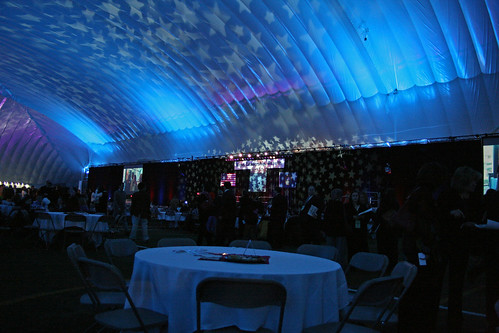
title=”The Stage by n1zyy, on Flickr”>The Stage

Media swarmed the place, since with Iowa done, we were the next big thing, second only to the news that Britney Spears was taken to the hospital…
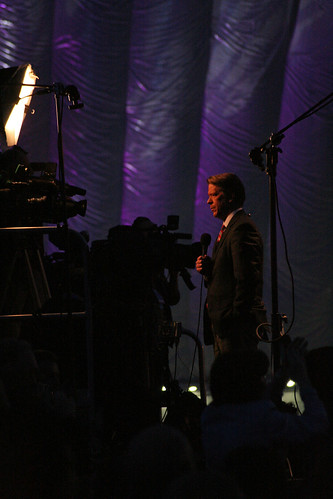
title=”Newscaster by n1zyy, on Flickr”>Newscaster

So really, the whole nation’s–even the world’s–eyes were upon us. It’s our time to shine… or to embarrass ourselves:
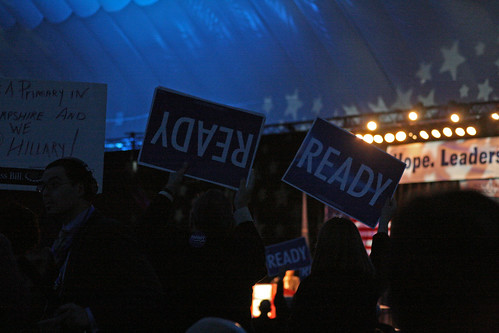
title=”Crikey by n1zyy, on Flickr”>Crikey

We were all there to see the Democrats running for President, but they made us sit through an awful lot of other stuff. For example, who–or what–is this?
title=”Eh? by n1zyy, on Flickr”>Eh?

Carol Shea-Porter spoke briefly. While I think everyone in the room was to credit, I was secretly proud for having voted for her. Not only is she spot-on when it comes to the issues, but she’s an outstanding speaker.
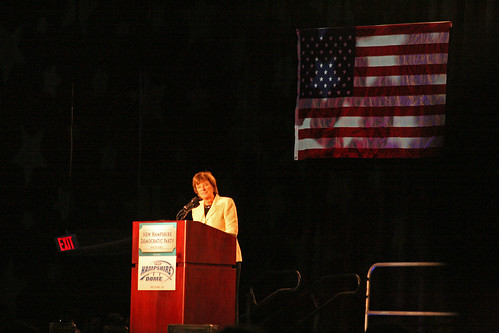
title=”Carol Shea-Porter by n1zyy, on Flickr”>Carol Shea-Porter

A few photography notes… For one, if you ever find yourself in charge of lighting at an event such as this, please consider bringing a photographer in to give you some guidance. The flag had really strange lighting on it. The goal with the black backdrop and intense lighting on the podium may have been to ensure that the background was non-distracting. It’s surely better than the glossy poster behind Bill Clinton. But it threw my camera’s metering through a loop, and I ended up shooting in full-manual mode most of the night. It was so dark that I was using ISO1600 at f/3.5 (as fast as my wide lens goes) and getting exposures of 1/15 second. Terribly dark. But then I was using ISO800 and getting 1/500-second shutter speeds shooting candidates. This is good, except that the light was really harsh, and all the lights were of different color temperatures. So our beloved flag was maroon, white, beige with a hint of blue, and black, while the whitest of speakers had intensely red skin. If the speaker was properly exposed, the podium was underexposed, and the sign in front was overexposed.
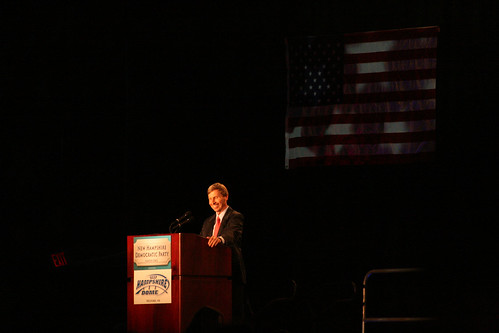
title=”NH Governor John Lynch by n1zyy, on Flickr”>NH Governor John Lynch

John Lynch, New Hampshire’s (Democratic) governor spoke a bit, too. Here you can see another problem: my 200mm lens (effectively 320mm with the digital camera’s crop) was far too short… They need to make a 100-600mm f/1.4 lens for situations like these. (Such a lens would probably weight at least 100 pounds and cost as much as a house, but it would take great pictures!) I honestly don’t know a lot about what Lynch has been up to, but it’s the same way I felt like when Clinton was president: things seem to run smoothly. National politics is a crisis week after week. With both Deval Patrick (MA Governor) and John Lynch, I think no news is good news. (I forget whether it was Lynch or Shea-Porter that mentioned it, but 2008 marked the beginning of civil unions in New Hampshire. So it’s not all no news. I’m frankly kind of proud that what much of the country probably sees as a quaint old farming state is at the forefront of…. rights?)

John Edwards was a no-show. I’m not sure what happened. I’d imagine that he was doing something else, somewhere else, but I’m really not sure why, especially after the surprise of beating Hillary in Iowa, he’d chose to avoid a forum with 3,000 New Hampshire Democrats and cameras from every news network in the country.

So Kucinich went first. While the Caucus results show him having received 0.0% of the votes, he didn’t seem phased by trivial polls.
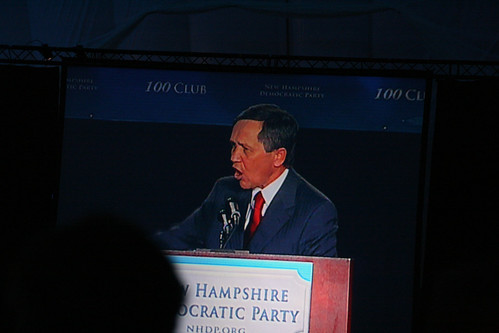
title=”Dennis Kucinich by n1zyy, on Flickr”>Dennis Kucinich

If you think this is an unflattering photo… You should have been there. I agreed with a lot of what he said, but it was how he said it that I think resigns him to getting 0.0% in important polls. He spoke about how it’s wrong to spy on our citizens (a reference to Bush’s wiretapping), and how we should end the war, etc. But he seemed almost as angry as on Hardball.

It seemed a lot like a fire-and-brimstone speech, except, instead of shouting about Jesus, he was shouting about the Constitution, and, instead of waving the Bible, he was frantically waving his pocket copy of the US Constitution:
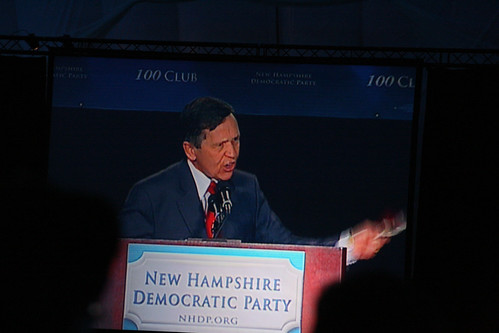
title=”Waving the Consitution by n1zyy, on Flickr”>Waving the Consitution

What pictures can’t convey is that he was furiously pounding on the podium and began jumping around a bit. Hopefully one of the news stations that was there will broadcast that.

It was assumed that this was his wife:
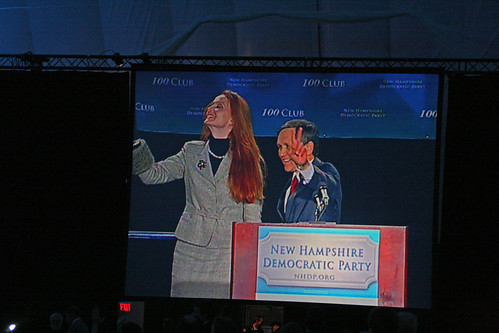
title=”Kucinich and…? by n1zyy, on Flickr”>Kucinich and...?

…although she appears more like a giant than a wife.

We also got to hear from Howard Dean:
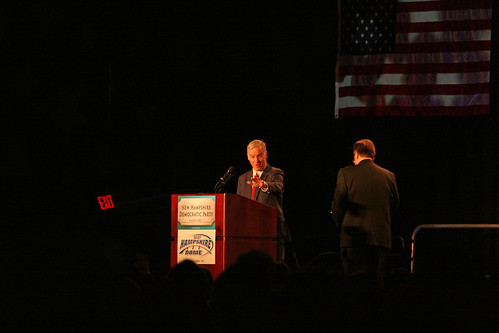
title=”Howard Dean by n1zyy, on Flickr”>Howard Dean

He was actually a great speaker, and has a quality I love in politicians: the ability to poke fun at himself a little bit. He started talking about the need for a strong showing not just in Iowa and New Hampshire, and then began to list a few more states with early primaries. “But they tell me I’m not supposed to do lists anymore,” he said, an obtuse reference to his infamous yell. And then he made the reference much clearer by pumping his fist and acting as if he were about to reenact it, drawing laughter and applause.

Tonight’s hidden gem was Bill Richardson.
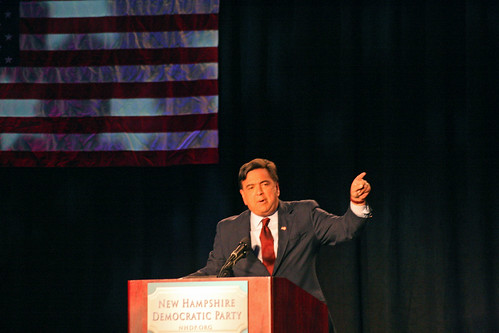
title=”Bill Richardson by n1zyy, on Flickr”>Bill Richardson

I’ve liked him for a long time, and he’s a very close second to Obama on my list of preferred candidates. (An Obama-Richardson ticket would be incredible! Hint hint, Obama!) While he doesn’t always photograph well (or maybe I just have bad timing), he sure knows how to give a speech. But perhaps most powerful was what he said about the need to pull out of Iraq. He talked, with evident sadness in his voice, about how he looks forward to the day when he can stop taking down the New Mexico flag to honor yet another of his residents killed in action. It was a really powerful way to put it, and the way he did it was flawless: it seemed like he opposed the war not just for political reasons, or as a soundbite, but because it truly pained him as governor to see his citizens being killed. Wow. Just wow. I really can’t do his speech justice here, but suffice it to say that I think his was the best.

title=”The Family by n1zyy, on Flickr”>The Family

And, of course, Hillary Clinton was there. I didn’t get (m)any pictures of her, because her supporters were standing and completely blocking the podium. (More on this later.) Bill and the much-forgotten Chelsea were there, too. But she began something that left me feeling uneasy: throughout the whole thing, there’d been an awesome sense of compatriotism. Some of us were there for Obama, some were there for Hillary, and some for other candidates. We were all in it together, not for our candidate, but for our future.

Hillary let loose a verbal barb clearly aimed at Obama, saying that we need strong leadership to end the war, not just hope that it will happen. This really rubbed me the wrong way–this type of bickering is exactly what has so many people fed up with politics. I also started to pick up on a sense of animosity between the Hillary fans and the Obama fans. I mentioned earlier that the Hillary fans crowded the stage and remained standing. None of us could see the stage, but with two enormous screens projecting a live feed, it wasn’t a big deal.

The Hillary camp somehow also wound up with all their tables right in front of the podium, while the Obama fans were assigned to tables in the corner. It turns out I was far from the only one to find this a little strange, as the Obama organizers decided to have us all stand and walk up to the stage when Obama came out. This ended up being an utter disaster, though.
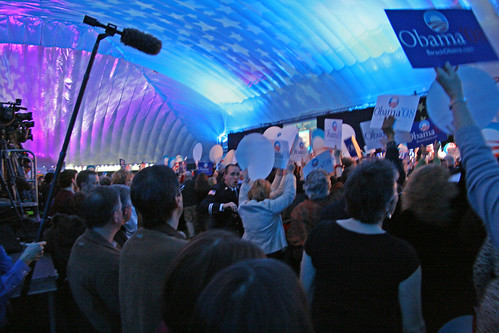
title=”Obama Signs & Fire Marshall by n1zyy, on Flickr”>Obama Signs & Fire Marshall

Since our seats weren’t anywhere close, we ended up blocking an aisle. This didn’t sit well with the fire marshall, who (emphatically) cleared the aisles. We were still standing, just with a big fire-safety aisle between us, but an announcer demanded that we sit down before the event would proceed. A number of Hillary supporters were also getting testy with us. While really just a minor thing, it seems to me to show a lot of deeper problems: Obama supporters ended up coming off as brash and obnoxious, and I think Hillary fans and Obama fans came to dislike each other a little bit more. This is what we can’t have happening.

Of course, not everyone sat down as requested, leaving those of us who can follow instructions to get some pretty lousy pictures.

Obama, as usual, gave a great speech. He talked a lot about hope (which sums him up well). But he indirectly had a great comeback to Hillary’s jab, saying that, while he acknowledges that he’s a “hopemonger,” it’s time for a President with a can-do attitude, as opposed to focusing on the stale ways of Washington that we’re all so fed up with. Unlike some of the other candidates, he really didn’t use the opportunity to give a basic “You should vote for me” speech, as much as a, “The time is now” speech.
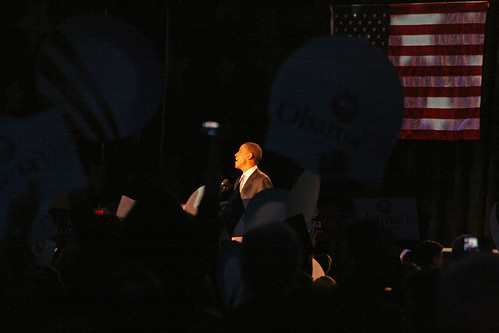
title=”Laughing by n1zyy, on Flickr”>Laughing

I suppose it’s neat to have him framed by his signs, but I’d hoped for better.
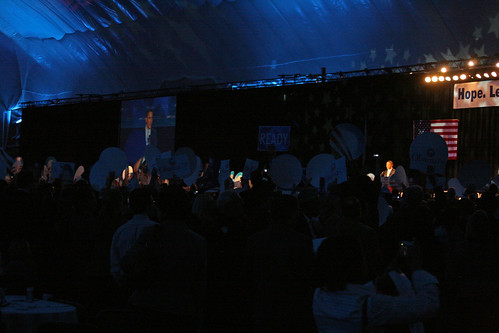
title=”The Crowd by n1zyy, on Flickr”>The Crowd

We’ve got a few more days to go. I’m attending a house party tomorrow (Deval Patrick’s coming), and it looks like there’s a Nashua Obama rally. Sunday’s more phonebanking, and Monday’s a Manchester rally for Obama. And then Tuesday is the day. And then it’s all over for us, with the candidates and the news getting a few days rest before scuttling on to the next primary. And an incredibly awkward period of waiting will emerge, leaving us in suspense for months before candidates are finally chosen.
9/11

While I don’t believe Rudy is going to make it far in the campaign, and while I really don’t like the attack ad element of politics, I’m frankly pretty appalled with Rudy Giuliani. I think it’s immoral to try to use 9/11 to your advantage. But Rudy’s use seems particularly insidious. He keeps suggesting that we need to vote for him if we want to be safe from terrorists. Besides the fact that his is creepy fear-mongering, what bothers me most is that there’s an unspoken (in this ad) implication that his leadership on 9/11 is what qualifies him.

It was a really crass comment, but a political commentator someone said something to the effect of, “Giuliani is an expert on terrorism just like the mayor of New Orleans is an expert on flood prevention.” While it maybe goes a bit too far, the point remains the same: what, precisely, about 9/11 makes him a qualified leader?

The IAFF (firefighter’s union) asking the same question. And if there’s anyone people respect because of 9/11, it’s FDNY. The IAFF essentially blasts Rudy for mis-handling things. One big problem I’d forgotten all about was the radio failures. They knew since the 90’s that their radios didn’t work inside the WTC, but repeated attempts to get it fixed never occurred. (They mention an “upgrade” that was actually so bad that they went back to their old radios, which is what they used on 9/11.) Tragically, more than 100 firefighters, because of these communication failures, never got the signal to evacuate WTC and ended up losing their lives because of it.

Some have also criticized Rudy for his decision to locate much of the city’s emergency communications infrastructure in the World Trade Center. Even if his common sense / expertise on terrorism didn’t tell him that this was an intuitively bad idea, previous attempts by al Queda to blow it up might have.

And if you’re not offended enough, give this a watch. I keep wanting to believe that this is a farce, with a look-alike mocking him. Except that all indications are that this is real. A Parkinson’s victim calls into a program Rudy’s doing on the radio to ask him why he took his food stamps and Medicaid away. Rudy cracks up laughing, mocks him, and offers to send him psychiatric help “because [he] clearly need it.” While Rudy surely didn’t know he was mocking a Parkinson’s victim, why would he treat anyone that way?!

Moral of the story: if you’re going to try to exploit 9/11 to win an election, you’d better make sure your botched leadership didn’t kill our firefighters. And you might want to refrain from going on public radio and cracking up laughing, and subsequently mocking, people who call in to say they have Parkinson’s and can’t afford their medication. But that’s just my opinion. I’m no political consultant or anything.

Update: For those that don’t read the comments, you should at least check out the link in this one for more of Rudy’s radio program.

Big Hosting

I tend to think of web hosting in terms of many sites to a server. And that’s how the majority of sites are hosted–there are multiple sites on this one server, and, if it were run by a hosting company and not owned by me, there’d probably be a couple hundred.

But the other end of the spectrum is a single site that takes up many servers. Most any big site is done this way. Google reportedly has tens of thousands. Any busy site has several, if nothing else to do load-balancing.

Lately I’ve become somewhat interested in the topic, and found some neat stuff about this realm of servers. A lot of things are done that I didn’t think were possible. While configuring my router, for example, I stumbled across stuff on CARP. I always thought of routers as a single point of failure: if your router goes down, everything behind it goes down. So you have two (or more) routers in mission-critical setups.

One thing I wondered about was serving up something that had voluminous data. For example, suppose you have a terabyte of data on your website. One technique might be to put a terabyte of drives in every server and do load balancing from there. But putting a terabyte of drives in each machine is expensive, and, frankly, if you’re putting massive storage in one machine, it’s probably huge but slow drives. Another option would be some sort of ‘horizontal partitioning,’ where five (arbitrary) servers each house one-fifth of the data. This reduces the absurdity of trying to stuff a terabyte of storage into each of your servers, but it brings problems of its own. For one, you don’t have any redundancy: if the machine serving sites starting with A-G goes down, all of those sites go down. Plus, you have no idea of how ‘balanced’ it will be. Even if you tried some intricate means of honing which material went where, the optimal layout would be constantly changing.

Your best bet, really, is to have a bunch of web machines, give them minimal storage (e.g., a 36GB SCSI drive–a 15,000 rpm one!), and have a backend fileserver that has the whole terabyte of data. Viewers would be assigned to any of the webservers (either in a round-robin fashion, or dynamically based on which server was the least busy), which would retrieve the requisite file from the fileserver and present it to the viewer. Of course, this places a huge load on the one fileserver. There’s an implicit assumption that you’re doing caching.

But how do you manage the caching? You’d need some complex code to first check your local cache, and then turn to the fileserver if needed. It’s not that hard to write, but it’s also a pain: rather than a straightforward, “Get the file, execute if it has CGI code, and then serve” process, you need the webserver to do some fancy footwork.

Enter Coda. No, not the awesome web-design GUI, but the distributed filesystem. In a nutshell, you have a server (or multiple servers!) and they each mount a partition called /coda, which refers to the network. But, it’ll cache files as needed. This is massively oversimplifying things: the actual use is to allow you to, say, bring your laptop into the office, work on files on the fileserver, and then, at the end of the day, seamlessly take it home with you to work from home, without having to worry about where the files physically reside. So running it just for the caching is practically a walk in the park: you don’t have complicated revision conflicts or anything of the sort. Another awesome feature about Coda is that, by design, it’s pretty resilient: part of the goal with caching and all was to pretty gracefully handle the fileserver going offline. So really, the more popular files would be cached by each node, with only cache misses hitting the fileserver. I also read an awesome anecdote about people running multiple Coda servers. When a disk fails, they just throw in a blank. You don’t need RAID, because the data’s redundant across other servers. With the new disk, you simply have it rebuild the missing files from other servers.

There’s also Lustre, which was apparently inspired by Coda. They focus on insane scalability, and it’s apparently used in some of the world’s biggest supercomputer clusters. I don’t yet know enough about it, really, but one thing that strikes me as awesome is the concept of “striping” across multiple nodes with the files you want.

The Linux HA project is interesting, too. There’s a lot of stuff that you don’t think about. One is load balancer redundancy… Of course you’d want to do it, but if you switched over to your backup router, all existing connections would be dropped. So they keep a UDP data stream going, where the master keeps the spare(s) in the loop on connection states. Suddenly having a new router or load balancer can also be confusing on the network. So if the master goes down, the spare will come up and just start spoofing its MAC and IP to match the node that went down. There’s a tool called heartbeat, whereby standby servers ping the master to see if it’s up. It’s apparently actually got some complex workings, and they recommend a serial link between the nodes so you’re not dependent on the network. (Granted, if the network to the routers goes down, it really doesn’t matter, but having them quarreling over who’s master will only complicate attempts to bring things back up!)

And there are lots of intricacies I hadn’t considered. It’s sometimes complicated to tell whether a node is down or not. But it turns out that a node in ambiguous state is often a horrible state of affairs: if it’s down and not pulled out of the pool, lots of people will get errors. And if other nodes are detecting oddities but it’s not down, something is awry with the server. There’s a concept called fencing I’d never heard, whereby the ‘quirky’ server is essentially shut out by its peers to prevent it from screwing things up (not only may it run away with shared resources, but the last thing you want is a service acting strangely to try to modify your files). The ultimate example of this is STONITH, which sounds like a fancy technical term (and, by definition, now is a technical term, I suppose), but really stands for “Shoot the Other Node in the Head.” From what I gather from the (odd) description, the basic premise is that if members of a cluster suspect that one of their peers is down, they “make it so” by calling external triggers to pull the node out of the network (often, seemingly, to just reboot the server).

I don’t think anyone is going to set up high-performance server clusters based on what someone borderline-delirious blogged at 1:40 in the morning because he couldn’t sleep, but I thought someone else might find this venture into what was, for me, new territory, to be interesting.

Transparent Government

As has happened in the past, it seems like the election has been reduced to 2 or 3 talking points–immigration, health care, and Iraq, to name the big ones.

I was brushing up on Obama’s stance on the issues, and found something that really excited me. Check out his page on ethics. It’s not vague talk about how lobbying is bad. He has an awesome plan:

  • A big database and Web frontend containing information on lobbyist activity, what they spend, and what bills are awarded.
  • Information on all federal contracts, how much they cost, who lobbied for them, and how the completion of the contracts is going.
  • Require that non-emergency bills be posted to the Internet for a few days before signing them, to promote “open government”
  • Do the same for earmarks, disclosing who added each earmark and why.
  • He also wants “21st Century Fireside Chats,” where Cabinet officials talk about what they’ve been doing periodically, streamed over the Internet for all to see.
  • Publicize meetings that shouldn’t be secret, such as “regulatory agency business.”

It’s ambitious, but boy would it be awesome! It’s funny: it almost seems like it’s somehow wrong that I should be able to see exactly what my elected officials are doing. And yet it’s really exactly what our government is all about: transparency. Wow-a-wee-wow!

High Dynamic Range

I’d been seeing a lot about HDR, or High Dynamic Range, photography. In layman’s terms, the dynamic range of a camera is the range from the darkest to the lightest parts a camera can record in one shot. The problem is that the dynamic range of cameras doesn’t match real life that often.

Long ago, photographers found a halfway decent solution: graduated filters. Basically, you stick a filter in front of the lens, with part of it darker than the rest. It’s great if, say, you want to take a great picture at the beach with both foreground detail and the sky properly exposed.

With computers, though, there’s been another photo. You take a series of bracketed shots: one or two for the sky, one or two for the foreground, etc. Some people have been known to stitch together close to a dozen. Having a tripod helps tremendously here, since the images need to be pretty much exactly the same besides exposure.

Strictly, HDR requires more than a monitor can really display, but a technique called tone mapping is often used. The basic premise is to take the “good” parts of each shot in a bracketed series and stitch them together. Photoshop CS2 and newer has an HDR utility, though I’ve been pretty unimpressed with the results. Today I started playing around with an Open Source tool called Qtpfsgui. It’s even cross-platform! It supports multiple algorithms for doing tone mapping, too.

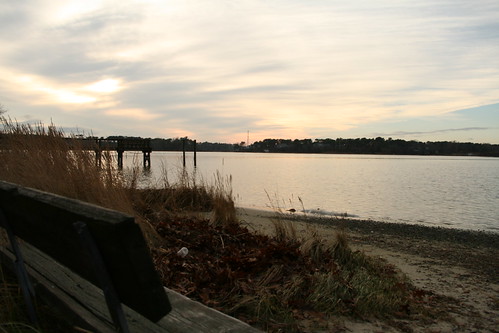
Overall, I’m still not that happy with the results, but it’s a start. Here’s a ‘normal’ shot of the beach, taken on Cape Cod yesterday:

title=”Beach by n1zyy, on Flickr”>Beach

You’ll note that the foreground (e.g., the bench) is too dark, yet the sky is too light. It’s a good illustration of insufficient dynamic range.

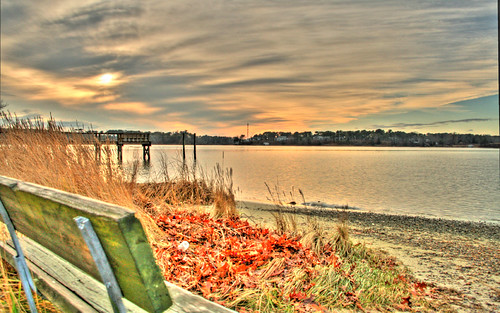
Luckily, I knew in the back of my head that I wanted to try my hand at HDR photography, so I saw it as an opportunity. I set my camera to meter -2 to +2 EV, to try to cover the full range. The end product:

title=”Fattal Algorithm by n1zyy, on Flickr”>Fattal Algorithm

It displays a very common pet peeve of mine with HDR photos: it looks entirely unrealistic. Absurd, even. I think part of it’s that it’s just overdone, and that the contrast is jacked way up. I want to play around with it more and see if I can get a more natural product. So far, no luck. But, at least in a technical sense, it’s an improvement over the first image.

I’d like to see HDR come a little further, so that HDR photos don’t have the same, “Whoa!” quality that a scary old lady with way too much makeup has. I don’t think the limitations are entirely technical at this point, either.

Benazir Bhutto

I confess to being ignorant enough to have not even heard of her, but Benazir Bhutto was a really interesting figure.

Now here’s an interesting video. You learn a few things. The first is that she speaks fluent English. The second is that she was widely aware of plots to kill her, and fingers a number of suspects in the video.

But the person who posted the video makes another interesting point. At one point she speaks of Osama’s son. Later on, she fingers a man “who killed Osama bin Laden,” an assertion which doesn’t seem to phase the interviewer.

The rumor’s existed for a while, but has generally just been peoples’ gut feelings and such. Now I’m intrigued.

Knots in My Stomach

Thanks Rusty for finding the Electoral-Vote.com website, something I’d forgotten about from the 2004 election. The data is in a bit of a confusing layout… Disregard the 2004 map and the first little table. He then has a comprehensive list of polls state-by-state.

My eyes are on Clinton:Obama. And I seriously have knots in my stomach here. Clinton is winning by at least 10% in most places. Arizona is 44% to 14%. In his home state of Illinois, Obama’s winning 37% to 33%.

The good news! Iowa, a key state, is slightly favoring Obama. But really, it’s a crapshoot: Obama, Edwards, and Clinton are neck-and-neck. Romney and Huckabee lead the Republican primary. At this point in time, though, my main concern is on the Democratic primary.

Here in New Hampshire, Obama’s trailing, 26% to 38%. This is not good. We’re #2 after Ohio.

Oklahoma’s weird. Obama’s got 13%, with Clinton and Edwards tied at 29%. (Don’t get me wrong: Edwards is good, but I don’t think he has a chance right now.)

The Republican one is interesting to take a gander at, too. In some places, Huckabee’s an also-ran. In Arizona, he got 3% of the votes. Once. In Iowa, he inches past Romney to take first place at 28%. Surprisingly (to me, at least), he’s doing the exact same thing in New Hampshire. With a quick skim (admittedly, much less than I’ve afforded the Democratic primary), it looks like Giuliani is king of the Republican race.

But a few thoughts:

  • I think the odds of Edwards winning the primary are slim. But he carries a substantial margin in some places. If he were to drop out and endorse Obama, the impact would be considerable. I worry that most of his fans would support Hillary, though.
  • I think we need to review the statistics after the Iowa caucus (January 3) and the New Hampshire primary (January 8). Everyone’s watching these, and the results will have a big impact. A strong lead by Obama may pull out some undecideds. Or, a strong lead by Clinton may freak out some people who will vote for Obama just to vote against her. (While I’d back her if she were our nominee, she is not my preferred Democrat, if you can tell.)
  • My super-early-money is on Clinton vs. Giuliani. And this concerns me greatly, because people voting on first impressions will probably favor Rudy without really doing a lot of research. (It also concerns me because I don’t particularly like either of them.)
  • The Republicans are getting weird results: Giuliani wins some places, Romney wins some places, McCain’s got a few wins (probably the least), and Huckabee, who I initially thought was the Kucinich of the Republicans, is actually leading in quite a few places. I’m really not sure who’s going to get their nomination.
  • As we saw in 2004, polls can be flaky. (I twice typed “pols” instead of “polls.” Freudian slip?) So this doesn’t necessarily mean anything.

One-sentence conclusion: It’s too soon to really have any idea how things will go, but Clinton has a discomforting majority in many states.

A few parting thoughts:

  • Read up on the Iowa caucus process if you’re not familiar. It’s quite foreign, really.
    • Apparently, only once in history (or once in five, put differently: an important distinction!) has the Straw Poll winner not matched the Iowa caucus winner. And this year’s Straw Poll winner was Romney. Both Giuliani and McCain screwed everything up by blowing the event off, and thus polled very poorly. I don’t know what this means: this might still tick off Iowa voters, tanking Giuliani in Caucus as well. But it also means that the data is probably skewed away from them right now, and if Iowa voters don’t have a vengeance, they may take votes away from Romney.
  • The Iowa Caucus is less than two weeks away, and the NH primary is less than three. Pay more attention to the statistics then.
  • Vote!

If Facebook Voted…

Top Presidential candidates, and their current number of supporters on Facebook:

  • Barack Obama, 174,650
  • Hillary Clinton, 56,935
  • Ron Paul, 45,906
  • John Edwards, 26,255
  • Mitt Romney, 23,155
  • Fred Thompson, 19,311
  • Dennis Kucinich, 18,587
  • Mike Huckabee, 17,161
  • McCain, 15,320
  • Rudy, 13,043

The numbers are interesting. Obviously, this isn’t a scientific poll, but I think it’s useful as a straw poll of where young people come down. And Obama is dominating, with about three times the support of his next rival, Clinton. Ron Paul is close on her heels.

And then there’s a huge gap, with Edwards at the front. I’m somewhat surprised to learn that Romney is right behind him, and even more surprised that Fred Thompson is next on the list. No offense to him, but I’d never considered him a viable candidate. He just slightly nudged out Kucinich, who’s about as likely to win as Thompson in my mind. Rudy and McCain, who I’d thought would be front-runners, are way down at the bottom. (Technically, it’s not the bottom, but I left off people way down there… Poor Richardson, who I would vote for in a heartbeat, has 8,272 supporters.)

Of course, we know that young people have the least voters of any age demographic… But imagine if we changed that this election. I hope to.

Why I’d Go Nikon

Andrew’s biased me. I’m a Canon fan. I own a Canon body, and now, two Canon-mount lenses. And this brings in switching costs: the lenses would be useless to me if I had a Canon. And, while I think it’s mostly irrational, I’ve come to love everything about Canon cameras and see any difference as a flaw in Nikons.

But I’m still excited about the Nikon D3. And it turns out that I’m far from the only one. The D3 has a ton of people anticipating its release. And even at 5 grand, I wouldn’t be surprised if they’re sold out at first. I don’t have that much to spend on a camera, but if I were a serious photographer, I’d have pre-ordered mine already.  Why?

  • Higher ISOs mean you can get shots that you otherwise couldn’t. Or that you can buy cheaper (and lighter) lenses and still get good shots. Everything in photography is a trade-off: to increase shutter speed, you need to either raise the ISO (which raises grain), or use a wider aperture (which usually hits hard limits: your lens is only so good, and you pay through the nose for faster ones). Increases in usable ISO, though, come “free”–if you can suddenly take clean shots at ISO6400, as you apparently can with the D3, you can get shots that, frankly, were impossible on other cameras.
  • Higher ISOs can mean increased savings. To get really good shots when I can’t shoot above ISO1600 (or ISO800 if I want clean shots), I pretty much have to buy a faster lens. Pros have tens of thousands in high-end lenses for just this reason. They can get the shots I can’t. Suddenly, at ISO6400, I’d be on par with them.
  • A lot of cameras are using “cropped” sensors… The sensor is smaller than 35mm film, so only the center of the image coming through the lens falls on the sensor, effectively cropping the image. This is beneficial if you’re using telephoto lenses, as it’s essentially a “bonus” zoom. (A 200mm lens on my camera is equivalent to a 320mm lens on a full-frame camera.) But for people who shoot at the wide end, it’s a major pain. The crop gave rise to things like Sigma’s 10-20mm lens, which is ridiculously wide. The reason is that, on a 1.6x crop sensor, it’s 16mm equivalent at the wide end: right on par with existing lenses. A lot of lenses are being built just for these cropped sensors, which permits them to be lighter and cheaper. But people still prefer the full-frame sensors, so now there are two types of lenses floating out there. Nikon nailed it here: their camera will work with both. If you mount a lens for ‘cropped’ cameras, it’ll only use part of the sensor. If you mount a full-frame lens, it uses the whole frame.
  • They built a longer-life shutter. Bravo. (Actually, Canon did too…)
  • They improved the LCD to over 900,000 pixels. One thing that drives me nuts on the 10D is that the image is tiny and low-resolution. You have to spend time zooming in to see if it came out alright. And when you’re shooting live action, this means missing a ton of shots. So you shoot blindly, and then realize that the whole thing came out unusable.
  • They have a built-in guide, so you don’t have to carry the manual around. Again, brilliant! The menu also looks a little bit less like it was made in 1982.
  • When I talk about high ISOs, 6400 is just their ‘normal’ upper. As with most cameras, you can enable “Expanded ISO” mode, which gives you some more settings, with the catch that they’re somewhat noisy. But you can shoot at ISO25,600. This is just obscene, and I’m fairly certain that, until Nikon came out with this, no one had ever even thought about a camera being this fast.
  • They kept up a high shutter speed… Between 9 and 11 frames per second, in fact.

Something tells me that the folks at Canon are scrambling to develop a sensor this good.. I hope they are. Because I hate those stupid circular viewfinders on Nikon cameras.

Aside: I really hope the folks at Canon are also scrambling to develop a camera that ditches the shutter… I’m still at a loss to explain why it’s even in a digital camera.

Aside: Maybe they can steal my ideas and include a useful integrated WiFi chip… Or a built-in intervalometer. That’d be trivial to implement?