Spam

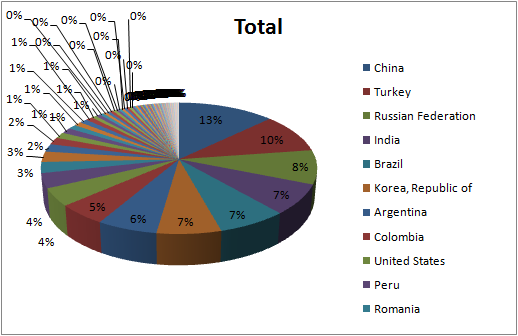
Since I was curious… A graph of spamming IPs I’ve encountered in the past 14 days (1,075) by country (78 total).

It’s only showing the top 11. (Excel’s decision.) Note that, as much as people love to blame China for spam (they are #1), the US is #9. (47 IPs, to China’s 139.) You could get the raw data (generated real-time) if you wanted to do your own analysis; Excel’s Pivot Tables proved quite handy in sorting and graphing the results. (Though I wish it was slightly easier to only include 10 values, yet have the values be for the whole data set… The top 10 account for less than 75% of total spam.)

I’d estimate that about 1,070 of these 1,075 IPs, by the way, are infected desktop machines. A new reason to keep your anti-virus current: so you stop sending spam!

The Google Phone

It looks like T-Mobile’s going to start selling a phone (made by HTC!) in about a month running Google’s Android. Engadget has more on the phone.

What interests me more than anything is its openness: Palm has an SDK, and so do most of the other smartphone makers. But none are totally free, or actively promoting their use. Android seems like the perfect phone for geeks.

They even had a Developer Challenge giving away lots of money for applications, with some neat ones as results. There’s another gallery of applications out there, too. T-Mobile has accidentally (?) published the manual online, and Engadget has an interview with the CTO, who basically says that, while they don’t really like unlocking phones / tethering, they don’t intend to cripple this phone.

iPhone? G1? Both?

McCain

So I’m admittedly biased against McCain, but I couldn’t help but find his decision to suspend his campaign to be… Strange. For some reason (maybe it’s because it’s what we did in school for years?), I couldn’t help but view it as a strategic move. And in that case, it was brilliant. For a candidate who admitted in January that “[t]he issue of economics is not something I’ve understood as well as I should,” and who, ten days ago, said, “The ” despite the difficult times, the move to suspend his campaign shows just how seriously he takes the issue. It’s so important that he’s putting aside his campaign to valiantly fix it.

The move was doubly brilliant, because while McCain suddenly gave the appearance as being very concerned about protecting Americans who’ve lost it all in the economy, it also leaves Obama looking like he’s selfishly continuing to campaign, ignoring the issue.

But Obama was quick to point out, “I think it is going to be part of the President’s job to deal with more than one thing at once… So in my mind, actually, it’s more important than ever that we present ourselves to the American people and try to describe where we want to take the country, and where we want to take the economy.”

The guy over at Electoral-Vote.com has an interesting piece up:

John McCain suspended his campaign, stopped running ads, and said he would not participate in the first debate scheduled for tomorrow at the University of Mississippi in Oxford, MS. He said that the nation is on the brink of a serious recession and this is no time for politics. McCain has been in the Senate 25 years. He knows precisely what will happen if he barges into the office of Sen. Chris Dodd (D-CT), chairman of the Senate banking committee and announces: “OK, Outta here, I’m taking over now.” … So why did McCain propose cancelling the debate? In a word: politics. By flying into D.C. as the savior he might appear as a man of action to people who don’t know how the Senate works. The reality of course, is that Obama and McCain’s appearance in Dodd’s office would instantly turn the entire event into a political circus.

Of course, he’s not so kind to McCain as he continues:

Balz says that McCain is an impulsive gambler and sees his campaign stalled, what with Obama rising in the polls, so he goes for a Hail Mary again. This is actually the third such gamble McCain has taken in less than a month. First, he picked an inexperienced governor who runs a state with a quarter the population of Brooklyn as his running mate. Then he cancelled the first day of the Republican National Convention due to a weather emergency. Now he wants to cancel a debate due to a financial emergency. There is an increasing risk that the voters will see him as an impetuous and reckless politician whereas Obama comes off as stable and mature. … The NY Times also has an analytic article on the politics of this. The view there is that Republican members of Congress know very well that throwing $700 billion at Wall St. in a big hurry with no oversight is not popular with the voters. On the other hand, they don’t want to buck their own President who still has a modicum of popularity with the the Republican rank and file. They are hoping McCain can bail them out. Democrats don’t want to be seen as obstructionists, but they also see the bailout for what it really is: a ploy to spend so much money that a future President Obama’s hands would be tied for lack of money. In effect this move is Bush’s attempt to “rule from the grave” by severely constraining what the next President can do. Oddly, it might constrain McCain more than Bush since he (McCain) has spending plans, too.

He also links to a survey of 1,000 Americans, in which 86% of respondents says that the debate should still be held. (50% saying it should be “Held as Scheduled,” and 36% saying it should be “Held With Focus on Economy.”) A plurality of respondents (46%) further said that it would be bad for America to cancel the debate.

And the debate isn’t the only thing that McCain called off. McCain was supposed to be on the Letterman show, but called Dave up to cancel. In this clip on Youtube, if you can get past the awkward first minute in which it almost seems like Letterman is getting paid for how many times he can work “John McCain” into a sentence, it actually blossoms into a pretty interesting piece. For one, Letterman seems to actually admire McCain, talking at length about how he’s a genuine war hero. But he also goes on to point out that suspending the campaign was a downright bizarre move, and that it’s especially odd that he didn’t send in his #2. (Or one of her many body doubles from WomenWhoLookLikeSarahPalin.com?)

What interesting times we live in.

/dev/*random

I thought I’d share my latest discovery. Linux has two “random number generators” as pseudo-hardware devices (that is, they’re in /dev, but aren’t actual hardware, much like /dev/null.) They’re called /dev/random and /dev/urandom. I never knew, or even thought much about, the difference.

/dev/random will “block” if it runs out of entropy. /dev/urandom is less secure in that it will keep serving data, but it will be from a less-secure pseudo-random series.

The difference is quite useful. For example, when encrypting something, it’s important to have “good” random numbers, hence /dev/random is indicated. On the other hand, the caching resolver I’m running (localish-only) on this server uses /dev/urandom: randomness prevents cache poisoning, but I really don’t want my DNS queries waiting for the “entropy pool” to get refilled.

As an aside, some tools to measure the effective randomness of your nameserver’s ports. Comcast, pretty impressively, ranks “Great” on the tests, as do the various caching nameservers in use on our webserver.

More on Spam Filtering

I tweaked the policyd rules and my main.cf a bit more, so that my mailservers lets PolicyD do most of the examinations. The net effect was that Postfix itself (my mailserver, or MTA to be more accurate) stopped rejecting as many hosts, instead allowing PolicyD, a plugin I use to do some more advanced filtering, to handle those hosts. And this is a good thing because Postfix would just reject the message, whereas PolicyD adds the host to a blacklist first.

I noticed an interesting change as a result, though: at any given time, fewer hosts were sitting in my greylist table, and more hosts were sitting in my blacklist. As I type this, there are 60 hosts in my greylisting table, and 985 hosts in my blacklist table. (This isn’t a totally fair comparison, as the blacklist keeps hosts for 14 days, while the greylist table keeps hosts for 3 days.)

I significantly revamped the page listing the banned hosts, both to cache the output (since each of the hundred hosts now involves running 6 DNS lookups and parsing two multi-meg text files), and to list a lot more output. I don’t currently use any DNSBLs (DNS blacklists), but set the page up to show whether a given host matches those blacklists.

At the time of this writing, 96 of the 100 most recent hosts have been in the Spamhaus XBL, which lists “hijacked PCs infected by illegal 3rd party exploits.” 96%! Spamcop is the next best blacklist, with 76% matching, followed by 64% matching results from the Spamhaus PBL, which lists IPs that are for “end-users,” like residential cable modems and dial-up lines: things mailservers shouldn’t be on. (If you’re like me, BTW, the answer is, “Yes, you can remove yourself” if you run a legitimate mailserver on those netblocks.) I’ve also had good results with the NiX Spam blacklist, which I found mentioned on the page for OpenBSD’s spamd.

I’m pretty strongly against using blacklists for anything definitive, as they’ve been historically fraught with problems and abuses, with many administrators eager to list whole netblocks, or even people they don’t like. And my simple setup seems to be just shy of 100% effective in stopping spam, so I have no incentive to go for blacklists anyway. Plus, this is an analysis of how spam shows up in blacklists, but that doesn’t tell us anything about how many legitimate e-mails show up in those blacklists, which is an equally important metric to consider.

But if I were to use DNSBLs, I’d give strong consideration to the following:

  • zen.spamhaus.org, which blends the XBL and PBL, plus a general list of spammers.
  • sorbs.net, which has myriad blacklists; pay special attention to “web” (127.0.0.7) and the dynamic IP list (127.0.0.10).
  • bl.spamcop.net, which is quite well-known.

Russia, Again

From the BBC today: Russian warships have set off for Venezuela for joint exercises unprecedented since the Cold War.

To my elected officials: please, please, please don’t allow for Cold War II.

I’ve for a long time perceived that increasingly large parts of the world hated us. And it’s easy to think, “So what if Venezuela hates us?,” or “So what if Iran’s crazy leaders hate us?” But what about when all of these countries start banding together, and get support by an increasingly-deranged superpower with plenty of nuclear weapons? Mutually assured destruction doesn’t work when the enemy is suicidal or just downright crazy. I’m really not convinced that the MAD theory would keep Hugo Chavez or Ahmadinejad from launching nuclear weapons.

Our current foreign policy reminds me of a schoolyard bully. We probably have the biggest and best military. We can stand up, flex our muscles, and get our way. But bullies don’t know how to use diplomacy and avoid fights, only how to come out bloodied but on top. We shouldn’t go praising Russia or Chavez anytime soon, but, uhh, it’s high time we did something other than goading them into war.

Canon’s 5D Mark II

This is what happens when I don’t follow camera news every day, apparently.

I’ve been ogling the Nikon D3 (and its smaller sibling, the D700) for a long time. They have lots of neat features, but the big one for me? ISO 25,600. That’s off the charts.

Canon finally did what I hoped they’d do, and matched it with the newly-introduced Canon EOS 5D Mark II. ISO 100 to 3200 “standard,” but you can unlock an extended range of 50-25,600, matching Nikon’s. (And Nikon’s is similar: 25,600 is a mode you can unlock, but that isn’t there standard, since it’s not perfect.) I’m yet to see any sample shots from it, so I don’t know how “usable” it is: my camera will go to ISO 1600, but it’s a little too grainy for my liking, so I consider ISO 800 to be the upper limit, with ISO 1600 as a last resort.

It’s also a full-frame sensor: most digital SLRs have a smaller-than-normal sensor, so they can only “see” the center of the image, which has the effect of cropping the image. (This is a nice “bonus” if you’re working with telephoto lenses, perhaps, but it’s annoying with wide-angle lenses.)

It’s got an absurd 21 megapixel resolution. I keep my 10-megapixel camera set to shoot at 5 megapixels, which is plenty big for me. Perhaps more interestingly, after adding Live View functionality (the ability to view a ‘preview’ of the image on the camera’s LCD, something normally impossible on an SLR), Canon joined Nikon in going for the next step: adding video capability. And this is no “consumer” point-and-shoot in terms of video: as you might hope a $2,800, 21-megapixel camera would provide, the 5D Mark II can record MPEG videos in full 1080p, 1920×1080 resolution, at 30 frames per second. (You may want to pick up some of SanDisk’s news 32GB CF cards before trying this.)

In addition to those major new features, the camera’s been cleaned up around the edges, introducing several features that I think will make a big difference. For some reason, Canon is notorious for putting crappy LCDs on their SLRs. The LCD on my camera is a huge step up from previous ones, and it makes me laugh to think about the postage stamp of an LCD on my old 10D. And yet it’s still not that great of a screen, given that I’m using it to try to judge minor details. (Is the whole subject in focus? Is the focus just right? Is it overexposed slightly?) Nikon’s been whooping Canon here for a long time, and, perhaps most irritating to professionals using Canon SLRs, Canon’s lower-tier point-and-shoot digicams have used nicer LCDs than their SLRs. Not anymore. The 5D Mark II comes with a 3″, 640×480 LCD. They’ve also apparently used some sort of anti-glare coating so that the LCD is finally useful outdoors. And they went a step further, and set the LCD’s brightness to match ambient lighting, so that it will automatically dim in dark rooms and brighten outdoors.

They also introduced Auto ISO. This is a neat feature to me, as it works in all modes except full manual. In general, I don’t care much about ISO. I want it as low as possible (to minimize noise), but I really couldn’t care less whether I shoot at ISO 400 or ISO 200. I care a lot about aperture, as it influences depth of field, and I also care a lot about shutter speed, which determines exactly what the scene will look like. So I usually shoot in aperture priority, where I set the aperture, and the camera chooses the optimal shutter speed. And all the time, I’ll adjust the ISO to suit, but it requires going into a menu to change. In its full-auto modes, the XTi has Auto ISO, but it’s not terribly useful. (ISO 100-400, and no one uses the full-auto modes anyway.) Now, it seems you can let the camera worry about ISO; it sounds like it’ll automatically set it as low as reasonable, abiding by the 1/focal-length rule. (The current ISO setting is also shown in the viewfinder; helpful for anyone who’s ever fired off a burst of shots only to realize that you’d forgotten to change ISO earlier, leaving you with a batch of horribly mis-exposed shots.)

“Lens peripheral illumination correction” was a term I had to look up. It’s an in-camera option to correct for vignetting. Neat!

One final thing I find interesting: the “Live View” mode already lifts the mirror, so they were able to take that a step further and introduce a “quiet” mode. With current SLRs, when you press the shutter, the mirror flips up, and then the shutter opens and closes, then the mirror goes back down. While there’s something satisfying about the tactile feedback, it can be a nuisance, especially if you’re trying to take photos in a really quiet place.

Overall, I’m quite impressed! I’m eager to see some sample shots at higher ISOs, and I’m also eager to be able to afford a $2,800 camera. 😉