SSDs and Asinine Arguments

I tend to get annoyed most of the time people talk about SSDs. There are two main arguments against them:

  • They don’t last long*, and
  • They’re expensive.

On the first point, this is more or less wrong. Everyone sees that they have a finite life and flips out, not realizing that the MBTF is usually several times a conventional hard drive. Someone else argues that this may be so, but that an individual sector can only be written to so often. (Which is the exact same argument that was just refuted?) Except that I’ve never seen an SSD that didn’t have wear-leveling. Furthermore, conventional hard drive get bad sectors, too. I’ve never heard anyone who actually knows what they’re talking about indicate a problem with the reliability of SSDs.

The second point drives me even more crazy. Of course they’re expensive. It’s asinine to even discuss. I can get a 128GB SSD for $300. I have two 2TB disks being shipped to me that, collectively, cost less. But can the 2TB disks do 200MB/sec. reads and have basically-instant seek times? Nope. It’s like trying to compare tractor trailers to Ferraris. It’s asinine to do.

The Lottery

I traditionally only “play” the lottery by buying a few dollars worth of tickets when the Powerball or MegaMillions exceeds $200 million or so. At that point, I’m not really playing because odds are good, but because it’s worth a few bucks to be able to dream about having hundreds of millions of dollars for a day or two until I lose.

I read an interesting theory about poor people and why they play the lottery so much more than rich people. It’s not necessarily intelligence or understanding of statistics, but that they think it’s worth a couple dollars to be able to dream about being rich. People who live comfortably really don’t see the value in giving up their money to dream that they have lots of money.

The other day, a couple coworkers each invested $2 in scratch tickets. Both ended up a few dollars ahead, so I thought it’d be fun to give it a whirl too. My $2 investment turned into $3. Since it was an inconsequentially small winning, I decided to reinvest the full amount today. One of the tickets was a $2 ticket, and it had a $10,000 prize; you could scratch 8 numbers and potentially win the $10,000 on each, I believe, so the advertised maximum jackpot was $80,000 or something like that.

I ended up winning $0, leaving me, ultimately, $2 in the hole. But what began to fascinate me was the psychology. The high-stakes $2 ticket netted nothing, but two of the numbers I didn’t match had a $10,000 prize: had I gotten a 9 instead of a 4, I would have earned $20,000.

We were discussing our newfound vice over lunch, and began to speculate that the $10,000 prize on a non-winning number might be deliberate. I didn’t really get the, “Wow, I lost 100% on that ticket!’ vibe, as much as, “Dude, I nearly won $20,000!” vibe.

I went back to the convenience store for a snack later, and decided to get another one of the $2 tickets. Half of it was that the irrational side of me said, “You almost won $20,000 last time, so you’ll probably clinch it this time!” The other half of me was the cynical side that bought the ticket to prove that the $10,000 non-winning-number was a deliberate psychological ploy. (And a little bit of it was that I was already there buying food, and had a lot of 1’s.)

Indeed, that ticket, too, had two $10,000 prizes on numbers I didn’t match, and I, again, didn’t win anything.

What I find so interesting is the psychology. I’m reasonably certain that the fact that I “almost” won $20,000 both times is deliberate. I also know that they’ve got to pay out more than they take in, so I know that my odds of winning $10,000 are really slim, probably something like 1 in 25,000 at best. (The odds aren’t on the ticket, but the thing informs me that I can request to see a sheet at the counter.)

And yet, knowing full well that I’m being fleeced, some tiny part of me says, “Third time’s the charm! How can you not spend $2 to try again? A few more times and you’ll have it!” And this, I think, is why the lottery does so well. Even the people who understand that the deck is (heavily) stacked against them have a little bit of irrationality encouraging them to do it again. I’ve gotten myself a whopping $4 in the hole, but I see regulars at the convenience store who spend $20 or more every time I see them, which means they probably do it every day. And I’m pretty sure that they think that, if they keep digging, they’re going to hit the jackpot any time now.
A Loser Blogging about His Plants

Having done it before, I thought I’d blog about plants some more, since I can’t think of anything more exciting to read about than someone else’s plants.

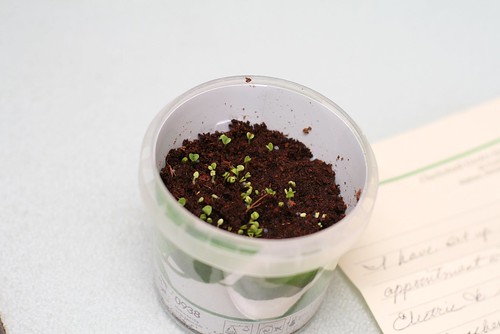
Last time I was at Ikea, I picked up a little $2.99 thing of basil. It has a little compressed disc of dehydrated soil; you just add water and it puffs up to fill the container. (This is creepy.) It took a long time, but when I got back from a few days away for Thanksgiving, the basil had sprouted:

Basil

This got me thinking, though… I don’t really do much with basil. I bought it mostly because it was $2.99 and it seemed fun, and Katherine convinced me it was a good idea. I think I’d much rather grow Rosemary or Peppermint or something. Garlic would be fun, even. It also seems that basil gets big, so I’m not sure this little pot will hold it as it grows.

This reminds me of a neat Lifehacker post, Three Plants that Give You Better Indoor Air. It seems to be suggested that you need crazy-person amounts of the plants to make a noticeable difference, but a few trips to Ikea (who knew they sold plants at all!?) have netted me a snake plant and an Areca palm, two of the three plants mentioned. (There are actually many more plants than those three that should work, though; check out Wikipedia’s List of air-filtering soil and plants). Another visit to Ikea got me a Norfolk Island Pine, maybe 9″ tall, just as an ornamental tree, not a natural air filter or oxygen-producer.

Lifehacker mentions that rosemary and lavender both require minimal watering, making them somewhat hard to kill, which only adds to my inclination to grow rosemary instead of basil. It looks like rosemary is hard (but possible) to grow from seed, so they’re mostly propagated by cuttings, not seeds.

As long as I’m citing Lifehacker about gardening, check out this neat post about growing something (e.g., moss) inside of a lightbulb as a DIY terrarium. Too bad most lightbulbs I have are frosted… Although it’s apparently possible to work around that. Here’s another page with tons of information on making your own terrariums.

Security Isn’t Paranoia

It’s easy to think of security as a negative action: keeping the bad guys out. A security guard is supposed to keep anyone bad from getting in, and question anyone suspicious. A firewall keeps out malicious network traffic. Anti-virus keeps bad software from running. Locks keep criminals and creeps from letting themselves in.

But security isn’t just the “negative,” keeping bad things from happening, at least in my book. Sometimes paranoid, “negative” security leads to what I think of as a less-secure environment. The other day I almost got locked out of my apartment. I think I want to give some neighbors — who are friends I’ve known for years — a set of keys. From a paranoid/negative-security standpoint, this makes me less secure: it’s like opening another hole in the firewall, or adding another window to a secure building. But overall, the odds of a criminal getting into my home are only nominally increased, but the odds of me getting locked out would be greatly decreased. Security isn’t keeping the bad people out, it’s keeping the bad people out and letting the good people in.

I’m also locked out of my work e-mail. Exchange (perhaps Active Directory) forces me to change my password periodically. Since I don’t use Windows, this manifests itself as me losing all access to Windows-based network resources until I can get a Windows admin to let me reset my password. [Aside: I think forced password changes are often counter-productive. I’m usually royally annoyed and choose something mediocre so I can quickly get back to work. This is where “password1” and then “password2” come from. No, my passwords aren’t that bad, but they’re not 30 characters of random symbols, either.] I also learned the hard way that several incorrect login attempts lock the account out.

To me, this isn’t security. It’s insecurity. For all I know, I’m receiving urgent e-mails about servers being breached or odd behavior noticed on the firewall, or something equally as important. But I’m oblivious, because I can’t get to my e-mail, and I have to wait until Monday to do anything about it. (It’s also a denial of service attack waiting to happen: if you have access to a list of employees, you can lock pretty much the whole office out.)

Ultimately, a security guard isn’t a zealot who shoots anyone who looks suspicious. He’s the guy who denies bad guys access, but who will use his master key to let you into your own place when you lock yourself out, provided he’s positive it’s really you and not your doppleganger.

Thinking Aloud: Home Network

I realized a while ago that I didn’t really have a “dream computer” build in my mind, but a “dream network” with a few interconnected machines. I’m kind of thinking out loud with this configuration; input is welcome.

I need a desktop. It’ll run Mac OS, but I can always boot into Windows when I need to. It’s got to have gobs of RAM, and I expect to have virtual machines running here and there. I’m going to want lots of storage, but it doesn’t have to be local. (More on this soon.) An SSD for boot and apps might be nice, though I figure it will stay running pretty often, so ample RAM might negate the need for this. I do want dual monitors.

I want plenty of storage, and I really, really want everything to redundant, which implies that RAID is needed. Many motherboards these days do hardware RAID, so this shouldn’t be too hard. (I don’t need battery-backed cache or anything.) I think the easiest way to accomplish this is with a dedicated NAS machine. An Atom-based setup might work, though I’m not sure how many Atom motherboards have onboard RAID.

I don’t have cable, and really don’t value TV at more than $10/month or so, which means that there is nothing I would pay for. But something like Boxee would support streaming from Hulu and such, and, frankly, looks really cool. I think the Boxee could sit on the same box as the NAS.

The downside is that I want my desktop and the NAS connected via Gigabit Ethernet, since otherwise I’d be capped at 12.5 MB/sec. throughput. (Or, if I did wireless, even worse… 54 Mbps is a bit over 6 MB/sec.) The problem is that my TV and my desk are at opposite ends of the apartment, with no Ethernet run. So I’m not sure how I’m going to make that work. I’m not sure running Cat6 is an option.

NewEgg Deals for Black Friday

I know I’m not the only geek here who shops regularly at NewEgg. I’m also pretty confident that I’m not the only person who won’t set foot in a store on Black Friday, but who loves deals. Here are some of the NewEgg deals I saw that jumped out at me:

  • Garmin’s Nuvi 205W GPS (4.3″), $99.99, a $90 savings. I love my Nuvi. (Although the maps are a bit out of date…)
  • The Nuvi 265WT GPS ($159.99, a $110 savings) also has a 4.3″ LCD, but adds live traffic feeds, and apparently acts as a Bluetooth speakerphone.
  • The TomTom GO 630 is the 265WT’s rival, though it seems to lack traffic. $169.99, a $129.96 savings.
  • Hitachi’s 2TB, 7200RPM SATA disk is $159.99 (a $10 savings), but there’s also a $30 mail-in rebate. Limit 5 per customer on the drives, not sure on the limits on the rebate.
  • If you need size but not speed in your laptop, there’s a Western Digital 640GB notebook hard drive (SATA), 5400RPM with a measly 8MB cache, though. $89.99.
  • Acer Aspire EasyStore H340, an Atom-based NAS with 2GB RAM, a terabyte of storage, and, apparently, 4 hot-swap drive bays. $299.99, a $100 savings. It comes with Windows Home Server, though I’d probably wipe it and put OpenFiler on it. And running a NAS on a single hard drive is a very bad idea: you move all your documents to one computer, so it has better run RAID across 2 or more drives. (Hmm… Pop a pair of the 2TB drives in it…)
  • Hanns-G has a 28″ LCD, 1920×1200, for $259.99, a $80 savings. With free shipping.

TuneUp Promotion

I’ve been on the fence about buying TuneUp for a long time. On one hand, it’s a really neat way to fill in missing metadata and cover art for songs, and I have a lot of photos that need to be “tuned up” that way. On the other hand, it costs money and I’m frugal.

If you buy TuneUp Gold now through the end of December 4th and use code “THANKSGIVING” at checkout, you save 20%. It’s normally $19.95 for a yearly subscription, of $29.95 for a lifetime subscription. There’s a free version good for 100 songs and 50 pieces of cover art, too.

I’m buying it after Thanksgiving dinner.