A Plea to Camera Makers

Dear camera makers,

Canon’s 1Ds Mark III is 21 megapixels. Please, acknowledge that Canon has won on the megapixel front, and move on. My camera’s resolution is 6 megapixels, and I have a flawless 20×30″ print from it. 21 megapixels is too many for most uses. Going further is wasteful.

Nikon has the right idea, though: improve things other than resolution. My camera maxes out at ISO3200, and the pictures are very bad there. Sometimes, though, ISO3200 isn’t enough. In a dimly-lit room, there are times when ISO3200 still gives me 1/8 of a second or slower shutter speeds. My lens is pretty slow, with f/3.5 as its widest, but even using something like Canon’s 50mm f/1.2 lens, I might not be able to get a useful shutter speed.

Nikon’s D3 goes up to ISO25,600. The images are practically useless at that point. But at least they’re trying. To you camera makers, I present a challenge: top them. I want to be able to shoot at ISO25600 (“25K?”) and get clean images. Can you do it? I bet you can, especially if you quit trying to one-up unnecessarily large resolutions.

Oh, and give us innovative new features, too. Or let us write our own apps! Why isn’t there “aperture bracketing?” Say I’m not sure whether f/4 is enough depth of field. Why can’t I take the picture at f/4, f/5.6, and f/8 and decide afterwards?

Why, on a camera body that cost $2,000 new, is there no “intervalometer” to let me, say, automatically take a picture every 5 seconds? I can buy a $150 accessory to do it, but is it really that hard to make it a software feature?

HDR photography is all the rage. Why not have an “HDR Composite” feature, that will meter for the darkest region, meter for the brightest region, and automatically bracket across the whole range? (Bracketing is not at all new, but it’s “dumb” bracketing — I can do +1/-1 or +2/-2. What if I want to go from +3 to -5 in 16 steps?)

Why do no cameras have an embedded GPS? It’s not the most useful feature, sure, but it’s cool. Make it a “module” people can upgrade to. I’d be awfully tempted to buy it.

It’s slowly becoming a reality, but why not have a USB2 port and let me plug in accessories? Currently USB2 ports are just for copying images to your computer. Why can’t I stick my thumb drive in and record to that? Or my external hard drive? And why can’t I just copy pictures over to my external hard drive right from the camera? Why do I need a computer?

Why are the LCDs on back such low-resolution? Play with an iPhone for a while, at 160ppi, and then look at any camera’s LCD. It looks like comparative crap. That LCD is important, too: I’m trying to see how my image out. Why would you give me a piece of crap for that? I’m yet to see a camera with an interface that doesn’t look like it predates Y2K, either. Again, play with the iPhone. It just looks cool. Don’t overdo it, but would it kill you to at least make the interface on your cameras look nice?

Some really high-end lenses have an IS/OS feature — basically, the lenses compensate for minor shake through the use of a gyro. This feature gets rave reviews from anyone able to afford the $2,000 lenses. Why not build an IS sensor into your camera instead, so that, regardless of lens, your sensor stabilizes for minor shake?

Please, camera makers of the world, quit it with megapixels. Let’s go for some innovation.
Shirt

Rusty and I usually don’t see eye-to-eye on style. But when he sent me a link to this shirt, I knew he was onto something.

Granted, it’s not out yet. But that doesn’t mean I’m not going to be ordering one. Not only is it “geek chic,” but it’s functional, too: I often wonder if there’s a good WiFi signal in various locations.

As an aside, tell me that this doesn’t fill a need in your life. And seriously, I’m buying this. Which makes me wonder… Bluetooth is 2.4 GHz, too… Will it false-alarm my shirt?

The Latest & Greatest Cameras

Canon and Nikon are like the Coke and Pepsi of the photography world. And if you have a Canon camera, the lenses for it won’t work with a Nikon camera, and vice versa, so you’re effectively locked into one or the other.  I’m a Canon guy, so I don’t really follow what Nikon’s doing much. But it turns out that Canon and Nikon have both just recently come out with amazing cameras.

Nikon just released the Nikon D3, which as some awesome features:

  • It’s got an orientation sensor that shows you how ‘level’ the camera is.
  • Dual CompactFlash cards, and you can use them several ways: double your storage, mirror them (I should note that CF card failures are probably far rarer than hard drive failures, so this is insane reliability), or store RAW images on one and JPGs on the other.
  • HDMI output.
  • ISO6400 as a standard feature.
    • ISO is how sensitive the camera is to light. A higher sensitivity lets you get pictures in darker settings, but raises the amount of noise (grain, essentially “static”) on the image. Most consumer cameras go ISO100-400. I can shoot up to ISO1600 without much noise, which lets me get a lot of shots I otherwise wouldn’t. I also have “ISO Expansion” unlocked, letting me bump up to ISO3200 when necessary, but at the expensive of pretty grainy images.
    • ISO6400 is the highest before you unlocked expanded ISO!
    • It goes up to ISO25600. Please excuse me while I drool. Unsurprisingly, ISO25600 is extremely noisy, but at the point, no other camera on the planet would even be able to take the picture, so some noise is an acceptable compromise. What interests me, though, is that, short of ISO25600, it’s really not that noisy. Look at the gallery of this site. Those first two pictures are ISO3200, which I find really hard to believe: they look flawless! ISO6400 is perfectly acceptable, and really, ISO12800 isn’t bad. I wouldn’t use ISO25600 if I could help it, but you’d probably only be using it when all the other photographers put their cameras away because it was too dark to get shots.

Of course, a camera like that is meant more at the sports market, where speed is essential. Canon just announced something for the other ultra-high-end market: studio photographers.

The Canon 1Ds Mark III was just recently announced. What’s remarkable here?

  • It’s 21 megapixels, and it’s 21 megapixels on a full-frame sensor. Digital photography actually surpassed the ‘resolution’ of film long ago: if you were to take pictures on the best film and blow it up as much as possible, you’d get more detail if you used a high-end digital camera. But at 21 megapixels, Canon is closing in on medium-format cameras. Seriously, 21 megapixels.
  • Two neat ways to manage sensor dust (the sensor builds up a charge that causes dust to stick to it, which ends up showing up on pictures):
    • “Dust mapping,” where you can use software on your computer to map out the dust.
    • A high-speed (ultrasonic?) vibration of the sensor, which keeps dust from sticking. A few other Canon cameras offer this, too, but it’s still very new.
  • A fairly big image buffer, something I wouldn’t expect on a 21 megapixel camera… And 5 frames per second, which beats my 10D.
  • An optional wireless add-on.
  • As an aside, check out the photos page and check out how obscenely wide the 85mm f/1.2 lens is.
    • And now imagine… 85mm f/1.2 lens… On the Nikon camera… ISO25600… You could probably see in the dark?

In conclusion, I need to win the lottery. 😉

Lens Rentals!

I came across Glass and Gear today, a lens rental place. Unknown to me at first, they’re in New Hampshire. I chatted with the owner a bit via e-mail, and am pretty impressed. The 85mm f/1.2 lens is amazing. (For $3 grand, it had better be.) It’s often touted as one of the best lenses for portraiture.  (There’s also the 50mm f/1.2 if 85mm is too long.)

I then did some more searching, and realized that there are a lot of lens rental places out there. This place has the “Bigma” 50-500mm lens for just $49 for a week. Much more expensive, but there’s also the 600mm lens if you really need the best of the best.  And at $300 a week it’s not cheap, but they even have the Canon 1Ds Mark II body, currently the best camera Canon makes. 16 megapixels, full-frame, for a mere $7,000.  (The 1D Mark III is also incredible, but is aimed at sports photographers and the like; it can shoot at an incredible ISO 6400, a self-cleaning sensor, and it can capture so many photos a second that many have referred to it as a “machine gun” camera.) They seem to be the only place with good lighting rigs, too, for studio photography.

There’s also RentGlass.com, which has a Sigma 30mm f/1.4 lens, for a mere $24/week. And the 24mm tilt-shift lens.

Oh, there are also super-macro lenses. It might be worth comparing prices on anything you’re going to rent (and looking for reviews: I haven’t done that yet!), but I was just surprised to learn how much is out there. Of course, being the first ones I found and practically a neighbor, I think Glass & Gear would be my preferred vendor. When the foliage gets a little nicer and I’m home for a nice crisp autumn weekend, I think I’m going to have to try an 85mm f/1.2 to get some good family portraits, and something like the Bigma to finally get some good moon shots.

More Photos

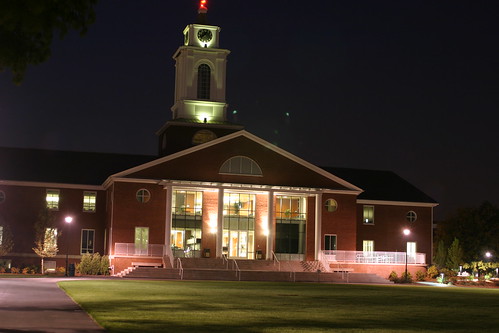
So yesterday I went into Boston to take some pictures, and last night I brought out the tripod and did some long exposures. The 10D shines at night exposures: a lot of cameras get very noisy on long exposures. This one was clean as a whistle. (A saying which really doesn’t make a lot of sense to me?)

title=”Photo Sharing”>Library

Note that the martians above the library to the right of the clocktower are actually just the crappy UV filter on the lens reflecting light.

title=”Photo Sharing”>300D Test Shot

That’s with the other camera, the 300D, that I’m trying to sell.

title=”Photo Sharing”>State House & Gen'l Hooker

General Hooker outside the Mass Statehouse. (Note that there’s strong evidence that he didn’t inspire the slang term for prostitutes: “hooker” was in use before he came to fame.)

title=”Photo Sharing”>Boston Skyline

Shot out the window the T, and now my background.

title=”Photo Sharing”>Zero Church

A church in Cambridge. I’m not sure why I like this shot so much.

It’s just awesome to take pictures and have them come out alright! (Although, really, I still have some practicing to do… I have an awful lot of unpublished bloopers, too.)

They’re Here

The cameras arrived today… Some first impressions… The 10D is big. I have one of the larger ‘point-and-shoot’ models that Fuji makes. But this thing is way bigger. It felt kind of awkward carrying it around. It’s not uncomfortable to hold or anything of the sort, it’s just big. It’s also pretty heavy. The 300D is considerably smaller and lighter. Between the silver color, the light weight, and the fact that something rattles, it feels much cheaper, though.

It just feels like a ‘real’ camera. You take a picture and the shutter sound is actually the shutter, not a cheesy sound effect that only plays when I forget to mute it. With a ‘real’ sensor size, I’m not cursed to always having everything in focus. (Which sounds desirable, but tell me you’ve never wished the background was blurred.) Using the preset modes, the camera seems predisposed towards popping up the flash when I least expect it, but it’s usually necessary.

I haven’t yet figured out how to change ISO settings. The 10D officially goes to ISO 1600, but allows an ‘expanded’ ISO setting of 3200. It’s pretty clean at that point, too. Most cameras get extremely noisy/grainy. The 300D goes to ISO1600; I played with it briefly there and it’s kind of noisy but still decent. Staples had a 1GB CompactFlash card for $13, before a $5 rebate, that I picked up this morning.

The lens it shipped with (used, not standard) is a 35-80mm f/4-5.6 lens. It’s halfway decent. The thing is that both of the cameras are the ‘APS-C’ sized sensors, which aren’t full frame, so they only capture the center of what’s coming through the lens. Therefore, there’s a 1.6x ‘crop factor.’ In layman’s terms, you’re ‘zoomed in’ an extra 60%. So the 35-80mm lens becomes a 56-128mm lens. I’d prefer something wider for general use, but it’s a free lens, so I won’t complain too much yet. I took it off to move it to the other camera, and noticed that it’s extremely light. Which, at least in lenses, isn’t really a good thing.

What would a camera ‘review’ be without pictures?!

title=”Photo Sharing”>First 10D Image

It’s a really lame picture, but it’s the first one so it’s obligatory to include it. Note the overexposed portions as the flash popped up.

title=”Photo Sharing”>Shallow DOF

This isn’t a remarkable picture either. But it shows one thing that I’m already loving: the shallow depth of field. (Of course you can use smaller apertures to overcome this.) I can’t tell you how many times I’ve wanted to take a picture and have the busy background be thrown out of focus. I was resigned to shooting in macro mode which kind of did it. Now it’s the real deal.

title=”Photo Sharing”>Macro-ish

Getting better, though it’s still nothing I’d frame. This one was testing something else: macro mode. (Actually, I hadn’t yet discovered that the camera had a macro setting. I just wanted to see how close I could focus.) I can’t get half an inch away, but this is plenty close for most sane things.

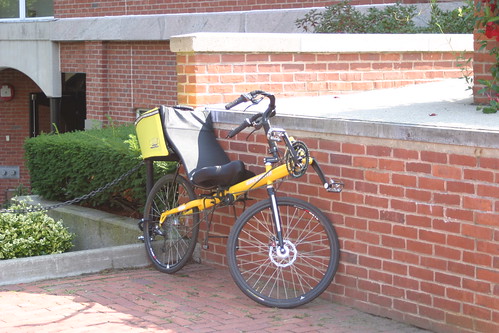
title=”Photo Sharing”>Neat Bike

I thought that bike was kind of neat. This wasn’t necessarily meant to showcase any special features, although I will note that nothing seems lost in the shadows. (I’ll also note that these photos are straight out of the camera: most people, regardless of camera, will do some tweaking first. I just put them straight up. So they could all be even better.)

Oh, and if you’re in the market… I’ve got an extra. 🙂

Long Shot

If I were to offer a used Canon Rebel 300D digital camera, with battery but no lens, for $250, would anyone bite? (Review of the model here.) I don’t currently have it, but I’d guarantee it to be in working order. (In other words, I’d be taking the liability on purchasing it.) Or $275 with lens.

The reason I ask is that this is a very good deal, but I only want the 10D. I’d love to let someone else benefit from the good deal along with me.

N.B.: This is not a binding offer, just a solicitation of interest. I may very well not purchase this, and the auction ends in 3.5 hours.

N.B. 2: This offer really only applies to people I know…

The Perfect Radio

So as anyone who’s seen me in person will surely know, I have a lot of radios. I’ve sold a few lately, but I’ve owned a wide variety. I have the VX-2R, one of the smallest radios ever produced. It’s got an incredible frequency range, too. I have the ASTRO Saber, one of the biggest radios ever made, capable of APCO25 digital voice, trunking, and MDC ID decoding. I’ve owned police scanners and mid-range radios.

Perhaps unsurprisingly, I’ve found that there are big differences between a tiny, $200 radio and a gigantic, $5,000-new ($250 on eBay a decade later) radio. But the huge expensive one doesn’t always win out. If I were designing a radio (which I’d like to!), here’s what it would be like….

  • Medium size. The tiny radio is handy, but it ‘feels’ crappy just because it’s small. The Saber and ASTRO Saber feel like some of the most solid radios ever built, but they’re almost comically large. I want something in the middle: solid, with controls big enough to use, but something that I can put in my pocket.
  • A good speaker. I can turn my Saber / ASTRO Saber up halfway and hear it more or less throughout the house. By comparison, if it’s noisy, I can’t hear my VX-2 unless it’s pressed against my ear. And turned up all the way, it’s heavily distorted. This is probably true of the Saber-based radios, but you’d probably blow out your eardrums before you noticed the distortion.
    • The sound quality is just as important as volume. The Motorola radios have a nice ‘deep’ sound, whereas most other radios sound somewhat tinny.
    • It probably costs $5 more to include the best speaker ever put in a radio in. I’d gladly pay $50 to upgrade to a radio with substantially better audio quality. Why don’t more people include good speakers?!
  • Notch filter or similar. There’s lots of extraneous noise on most signals. It’s actually pretty easy to filter it out, and ‘base’ HF ham rigs have been very good at it for a long time. Something as simple as a notch filter would eliminate a lot of the nuisance noises and make listening much more pleasant. (You could do a lot with DSP and make audio sound much better, but someone should at least do the minimum…) This is also the place to mention that I’d really like it if your radio would do some volume normalization.
  • A good microphone. For normal ham radio stuff, this doesn’t really matter and any 19-cent microphone can be soldered in and work just fine. But ‘real-world’ stuff doesn’t work that way.
    • At work, I can almost never hear the mechanics when they’re out back trying to talk to me. They could be telling me that they’d like me to ask the snack bar to cook them a hamburger, or they could be telling me to shut down the machine because they have their arm stuck in the gears. I think a good directional microphone would be a big help here, in only picking up what’s directly in front of the radio and not the (very loud!) ambient noise. (I remain convinced that another microphone on the back of the radio, ‘subtracted’ from what’s coming into the front micrphone, could produce amazing results.)
    • Campus Police responds to a lot of fire alarm activations. The fire alarms are extremely loud, to the point that it’s literally painful if you’re there in person. You can only hear what they’re saying between the buzzing of the alarm, and even then it’s hard because it echoes. I don’t know that this can be solved easily, but I’m sure a good design could at least help.
  • A nice big screen. In ham radio, giving me eight characters is considered amazing. Many commercial radios just give you a numbered readout of what channel you’re on. The ASTRO Saber has an incredible 14 (I think…) characters. But even then, fitting “Boston PD Channel 4 – Area ‘E’ – West Roxbury, Jamaica Plain, and Hyde Park” is a chore. You end up with something like”BPD4EWRX-JP-HP,” which is not that helpful until you get very familiar with it. At which point you’ll probably know what Channel 4 means without the label anyway.
  • A sane way of organizing channels. Motorola gives you 16 ‘zones’ of 16 channels each for 256(ish) channels. (This is technically not true but it’s a practical limit.) Many ham radios just give you 200 channels. Some of the better ones (and some scanners) let you use ‘banks,’ which are sort of like ‘folders’ of channels. But there are almost always limits: a bank can almost always store 40-50 channels max, and you usually can’t assign a channel to more than one bank. In my mind, it’s idiotic to still have these limits. What if I want 60 channels in one bank? What if I want to have 72 banks? What if I want Campus Police in a “School” bank and a “Waltham” bank and a “Waltham – Active Emergency” bank?
  • Nuisance Delete! Motorola got this a long time ago, but until I bought the ASTRO Saber, I’d never heard of it since it seems like nothing else supports it. When you’re scanning a range of channels (which is, you know, what scanners are for), there’ll sometimes be one that you don’t want to scan. Maybe you have the police, fire, and the local ham repeater, and there’s a big fire going on. The police are scrambling to get someone out of the building while the fire department is attacking the flames. And then the scanner stops as someone on the local ham repeater discusses how he doesn’t really care for Taco Bell that much these days. Most scanners have a “Lockout” which will ‘permanently’ delete the channel from the list of channels it scans. Nuisance Delete is temporary and gets wiped out once you stop the scanning ‘session.’
  • Recording! Really, I can’t believe there’s almost nothing on the market that does this. I want to leave the radio ‘off’ (let’s call it “Standby Mode’) on the charger all day. And when I see five police cars go speeding by, I want to jump out of my seat, pick up the radio, and hear what the police dispatcher said two minute ago. I’m not aware of any radio that will do this. The thing is, voice takes up very little space. 64kbps MP3 would be plenty. Probably overkill. And a 1GB flash storage card is about $20. And I bet you could get it for a quarter of that if you were buying them OEM to embed as opposed to a consumer buying SD card. You could store weeks of audio. And how many times are you listening but you miss a key detail. (When I’m listening to try to figure out why the emergency vehicles went by, I’ll almost always hear, “We’ll be on scene with a –” “Hey Matt, do you know what’s up with that fire truck?”) It’d be great to just replay it.
  • Digital mode support. This is kind of vague, and could involve a lot of licensing / royalties. But public safety (law enforcement in particular) is very quickly moving to the APCO Project 25 Common Air Interface (generally “IMBE,” “P25,” or Motorola ASTRO). There are three scanners, out of probably 50, that do this mode, and their audio quality doesn’t compare to the genuine radios. There’s also trunking which is very common in cities. The ability to monitor paging networks (POCSAG/FLEX) is handy, but raises a lot of legal issues. (Intercepting other peoples’ pages is explicitly illegal and it’d be hard to design a radio that could decode the protocols without allowing people to see other peoples’ pages.) There are other experimental digital modes, too.
    • The best solution, IMHO, is to make the device run Linux (or any other common embedded OS) and release an SDK so people can write their own digital modes.
  • Muting of various junk, such as digital modes. These days I’m using the VX-2, and I really miss the ASTRO Saber’s “DOS [Data-Operated Squelch] Muting,” which would detect MDC1200 data traffic and mute the speaker. All too often what comes out of the speaker isn’t voice, but just various noise that gets transmitted over the air. It’s really not that hard to detect it.
  • A good battery. I should be able to use it all day, including periodic transmission, without recharging. (Motorola famously offers a 4,000 mAh battery for their flagship line of radios.)
  • A very readable display. Not just big as I said earlier. One of my radios is hard to see if I look down at the LCD. Another is hard to see if I look up at the display. Another is kind of washed out if the backlight is on. Anything with a graphic LCD (very few radios) is almost impossible to see in direct sunlight. (Frankly, I’m very impressed with e-ink displays like the Sony Reader, and would be obliged to buy a radio, no matter the price, that had one as an LCD.)
  • A frequency counter, to detect what frequency something is on. Generally you have to buy an external device to do this. The VX-2 is (as far as I know) the only radio ever made with a neat feature which is basically a ‘ghetto’ frequency counter: it’ll kick in a 100 dB attenuator and see what frequencies it can find, good for locating very close transmitters. But it’s not a real frequency counter. It seems pretty obvious to me that frequency counters and radios are generally used together, so it’s really kind of surprising that so few people have thought to blend the two.
  • Durability. I drop things. Public safety radios get it ten times worse. You’ll read stories about people dropping their high-end Motorola radios into the ocean, or someone dropping it and then backing over it in the fire truck. And they pick it up, dust it off, and realize it sustained almost no damage. There seems to be more of a focus on making things cheap than on making them durable these days, though. But we want durability! At the very least, I should be able to stand on top of the machines at work and drop your radio eight feet (or so) onto the concrete floor and just have to put the battery back on.
  • Scratch-resistance. Especially the LCD. For some reasons radios don’t seem to scratch as bad as cell phones and iPods, maybe because not many people put their radio in a pocket with their keys. But a lot of watches have faces made out of things like sapphire or crystal that are basically impossible to scratch. I’m sure this adds to the cost (watches like this aren’t exactly cheap), but I also bet much of that stuff could be grown in a lab. People do care when it’s for a wedding ring, but I’m pretty certain no one cares when it’s for a radio display covering.
  • Intuitive controls. I shouldn’t have to press ‘shift’ and then something else to perform basic functions. When it’s -10 out and my hands are almost numb, I should still be able to operate the radio. (And when I wise up and put gloves on, I should still be able to use it.)
  • Wide frequency range. I’d be interested in working the 6-meter ham band (50-54 MHz), the 2-meter ham band (144-148 MHz), VHF ‘commercial’ (136-174), the 220 MHz ham band, the 70 centimeter ham band (420-450 MHz), the enormous UHF commercial split (403-520 MHz), the 700-800 MHz public safety band, and the 900 MHz ham band. If I were to cover all of these, I’d probably need eleven radios. My little VX-2, smaller than a deck of cards, will happily receive all of them. There’s been one commercial radio that would let you transmit on more than one ham band, and that was discontinued a long time ago. (Many ham radios support several bands.)
  • Simple programming. I like FPP (front-panel programmable) radios, but there are legal issues on commercial radios that usually prevent this. It’s also handy to be able to program radios on a computer, especially if you have a lot of channels or want to program a lot of radios the same way. (Aside: why can’t radios share data over the air? There could be an ‘over-the-air cloning’ mode that uses something like spread spectrum to avoid interference, which could make programming a fleet of radios much easier.) And it’s also neat to share frequencies with other radio users. As far as the computer programming, though…
    • The interface has to be intuitive. Motorola’s RSS, somewhat of a standard (until their Windows-based CPS replaced it), is probably the least intuitive piece of software I’ve ever used. Programming the ASTRO Saber, I had a huge sheet of paper. On one screen, I’d input a “personality,” which was the frequency for a given channel. Then I’d have to map that personality into a zone, hence the big sheet of paper keeping track of what went there.
    • The software should be free, or at least included with the radio. (It should really be open-source, in my opinion, so people can enhance it.)
    • Programming should be quick. USB 2 allows 480 Mbps. Why are people still designing connectors that use serial ports? The last few computers I’ve owned haven’t even had a serial port. Not only is it obscure, but it’s so slow!
    • As long as the device is Linux-based, why not just have an /etc/channels.xml file or something? Using an open standard like XML, and making it just a file that anything can read/write over USB, would make programming ten times easier.
  • GPS. Ham radio has APRS. And frankly, I’m very surprised that there’s no public safety equivalent, especially as they all go digital. (Random aside: LTR trunking uses “subaudible data” to pass the relevant control information: they pass the data in the ‘audio’ range outside of human hearing, so it’s there as part of a signal but not reproduce as audio, so it’s basically ‘hidden’ in the analog voice signal. This is ingenious. In the 20 years or so since that began, I’m surprised that no one has ever thought to embed PTT-ID/ANI (e.g., a way of identifying which radio is which) data that way. And now you could embed GPS coordinates that way… But I’ve still never heard of it even being attempted.)
  • Tones and a vibrate function. Cheap “bubble-pack” radios have a “call” function that transmits a ringing sound. It’s actually very useful at work for getting one’s attention. High-end radios have things like “Private Call” that send a digital signal to a particular radio telling them to sound a bell to get the user’s attention. This is also handy. A vibrate function on phones is common for quiet areas but many will agree that the vibrate feature is actually most useful in very loud areas where you’ll rarely even hear your phone ring. I want the same on a radio.
  • Remote control. This isn’t useful for individuals, but is actually fairly common already in fleets of radios. Some existing uses:
    • Motorola’s OTACS: Over-The-Air Channel Steering. You could want all the firefighters at a given call to switch over to a fireground channel. Why not let the firefighters tend to the fire instead of their radios, and just send their radios a command to switch over?
    • OTAR: You can push out a new encryption key to all the radios in a fleet. (As inherently insecure as this sounded at first, it’s actually a complex process that’s incredibly secure.) This is important since, in a really secure setup, the key should be rotated every few days. It’s not practical to pull in all the radios for reprogramming every few days.
    • Remote inhibit. When a radio goes missing, dispatch can send an inhibit/stun command, which basically renders the radio a brick: a brick that silently keeps listening for an uninhibit/restore command. This means that if someone steals a radio, and it’s detected, they won’t be able to monitor you, much less interfere.
    • Remote transmit. Usually in response to an officer transmitting an emergency call or just not responding. Dispatch can send a command to the radio instructing it to begin transmitting audio, so they can hear what’s going on.
    • General reprogramming: I’ve never heard of this! It could be extraordinarily useful, though!
    • This whole thing needs to be encrypted/authenticated. The current implementations are not, which means that anyone with access to a dispatch console (rare, but they show up on eBay periodically) could, say, start sending inhibit commands to radios in the field. This could be really, really bad if it ever fell into nefarious hands.
  • A clock. Just a simple clock shown on the radio. (For bonus points, the radio should be capable of receiving the time over the air anyway from various atomic clocks, so you could have a very accurate clock if you were willing to take the time to program it.)
  • RSSI: I want to be able to see how strong the received signal is. Almost all ham radios do this. Very few commercial radios do. (RSSI stands for “Received Signal Strength Indicator.” Hams generally call it an S-Meter.)
  • Text messaging. A lot of departments will give their officers pagers, too, to send supplemental information. Why not just do it over the air in text form? Some of the newest Motorola radios support this, actually.

Today’s Crazy Idea

I’m constantly coming up with ideas. Much moreso than I suspect is normal. (At any given time I have about half a dozen ideas for new businesses floating around in my head.)

A lot of the times after a few minutes in my mind I’ll reject an idea for one reason or another. Other times I realize that it’s a really good idea and act on it. But today’s idea I’m not so sure about.

I think it’s very important that have a good retirement account. The money you earn is basically time times interest rate, and, while I can shop around for a good interest rate, you just can’t beat 40 years time when it comes to interest earned. ($2,500 today, with no money ever added, earning 10% annual interest, left alone for 40 years, would be a $113,000 retirement fund.)

I also noticed that I had a pretty ‘good’ schedule that I constructed back when I was on my ‘late’ sleep cycle: go to bed late and wake up late. I’m currently not on that sleep cycle, which means I’ll have lots of free time during the days. Mostly joking, I proposed that I should get a job to fill the time during the days.

And then these two random thoughts collided. The obvious result: why not get a ‘light’ part-time job during the days and earmark 100% of the earnings for contribution to an IRA?

Realistically, I doubt I’ll carry through. But I wanted to share the idea, because I really like it.

Deals

Most people probably like to read the comics in the Sunday paper. I like to read the circulars. Every week there are good deals. But sometimes, there are great deals. And this week, there are several. (N.B. that most of these have rebates attached to them.)

  • $600 buys an HP Pavilion notebook with a dual-core AMD Turion processor, 120 GB hard drive, 14.1″ LCD (“Brightview Widescreen” no less), CD/DVD burner (with “LightScribe Direct Disk Labling”), a built-in webcam, Vista Home Premium, and, get this, 2 GIG of RAM. This is a monster of a machine, and $600 is just insane. [Office Depot]
  • What I think is three reams of (store-brand) recycled paper, $16.99. [Office Depot]
  • eMachines Athlon 3800, 1 GB RAM, 160 GB disk, dual-layer CD/DVD burner, Vista Home Premium. No monitor, but an all-in-one printer/scanner/copier. Not a spectacular machine, but $299.98. [Office Depot]
  • Refurbished HP all-in-one machine, with a card-reader and 2.4″ LCD. I’m not a huge fan of refurbished stuff, but $49.99. [Office Depot]
  • Store-brand 75-pack DVD-R and 25-pack CD-Rs, $7.99. [Office Depot]
  • 300-amp jump starter kit, $19.98 at Pep Boys. Or pay $49.98 for a combination jump-starter (rated at 450 amps) and an air compressor.
  • Lexmark X1240 all-in-one machine (printer + scanner + copier). $27 at Target. Why shouldn’t I buy this? (The fact that I don’t need one is not a valid answer.)
  • $37 at Target gets you your choice of a Uniden 5.8 GHz cordless phone system (two phones!) with answering machine, or a Philips DVD player. Both seem absurdly cheap.
  • 30-pack DVD+R or DVD-R, just $4.99 at CompUSA.
  • 500 GB external Seagate FreeAgent drive (USB 2.0), $117.99 at CompUSA.
  • Intel Q6600, the quad-core 2.4 GHz processor. $289.99. I swear these were $600-900 a month ago.
  • 7-inch LCD digital picture frame (no brand mentioned), $49.99 at CompUSA. At several hundred dollars these picture frames were pretty silly. At $50, it’s a potential gift.
  • An Iomega 1 TB external drive (based on size, it looks like it may be 500+500 or something), for $249.99 at CompUSA.
  • A pack of eight good ol’ Dixon #2 pencils, one cent at Staples. Limit 3 per customer. I stopped using pencils when I realized that I’d just scribble out mistakes instead of erasing them, but 3 cents for 24 pencils…
  • Brother QL-500ec [on Amazon] computer-based label printer, $64.99 at Staples.
  • $750 at Staples gets you a dual-core AMD Athlon 4200+, 2 GB RAM, 320 GB disk, 19″ HP LCD, DVD burner (LightScribe), built-in tuner [no word on HDTV?], 15-in-1 card reader, and Vista Home Premium.
  • $19.98 buys a 1GB Micro SD, xD, or Memory Stick Pro Duo memory card for your cameras. (Or Treos!) If you’d rather 1GB in SD or CF, it’s just $12.98. [Staples]
  • Also at Staples, $69.98 gets you an HP all-in-one machine (apparently not refurbished).
  • 10-ream (5,000 sheet) boxes of paper are $29.99 at Staples.
  • Amazon has this nice OBDII reader for $69.99. Most of our cars are pretty new so we don’t have a lot of problems, but I’m still tempted…
  • Amazon also has my shoes for $30, which is an absurdly good deal. Considering that I’m perfectly happy with them and was going to spend like $90 on a new pair of shoes, it seems silly not to buy them.

I think I’m off to go shopping…