Digital Radio

There are a few different technologies commonly used in two-way radio. One is digital voice, a la Motorola ASTRO / Project 25’s CAI (IMBE), which is a 9600bps (9.6kbps) digital stream. Another interesting technology is trunking: a city might have 12 talkgroups (think “virtual channels”), but only 4 frequencies. One frequency is designated as a “control channel,” which is a digital stream announcing system status. When you want to transmit, your radio will go out to the controller and get assigned one of the frequencies, and the system will then announce that you’re transmitting on one of them, and all radios in your group will switch over and listen. This allows much greater spectrum utilization: rather than needing a new frequency for every group that might want their own channel, you just need to license enough frequencies for however many simultaneous conversations you expect.

I’ve been thinking that it’d be interesting to merge the two technologies. Technologies like Speex will let you process audio at exceptionally low bitrates, seemingly as low as 3.4kbps. (And they have some neat technology, like variable bit-rate encoding and even further drops in data transfer in between words, dropping quite low for when it’s just background noise.) So I think it’d be neat to start a “data network” at 32 kbps, which could be done with relatively low bandwidth. You could keep one frequency, and yet fit as many as 7 or 8 simultaneous conversations on it. (And you can take its VBR support one step further, and have it scale to fit system capacity: on a system with minimal activity, allow 8-16 kbps, but when the system is starting to fill up, drop down to 4 kbps.) HE-AAC (also known as AACPlus) looks promising too, although it’s a proprietary technology.

And since it’s now a 100% data network, you can do what I’ve always thought mobile radio systems, especially those used by public safety agencies, ought to do: put a GPS unit in each radio, and have them embed GPS coordinates in each transmission, as well as periodically announcing their coordinates in the background.

The net result is insanely efficient (radio) bandwidth usage. For example, Boston PD has 16 frequencies licensed, but it’s rare for more than 2 or 3 to be in use at any given moment. They could get more efficient by switching to a trunking system, maybe with 5 frequencies (plus a control channel). Of course with an established system, there’s really no incentive to, but I digress. But if they could get entirely usable digital audio at 3-8 kbps, they could actually move to a single frequency and support multiple, simultaneous conversations.

Another neat side-effect is that linking the systems would get quite easy: the entire system, with multiple conversations, could even fit over a single dial-up modem link. And you can have better “emergency” support, although most trunking systems seem to do it anyway: public safety radios carry an “orange button,” which will signal an emergency to the radio system. Analog systems do this by basically making the radios “obnoxious”–they’ll just keep transmitting a distress signal over and over, increasing the odds that they get through. With an all-digital system, they can just send packets indicating an emergency, and have the network make way for them, going so far as to terminate existing conversations if needed.

Oh, and another novel benefit is power management. If I’m on a handheld radio and I’m standing twenty feet away from the tower, I can dial my power down as low as it goes and still make it in fine. But if I’m a few miles away, I need to be using the highest power I can to make sure I’m making it. Of course, no one in the field fiddles with power settings. (In fact, most radios don’t make this something the user can do.) But if you just exchange a bit of signal strength info in the data flowing between radios, you can make this automatic. As I talk to the tower, it’ll be periodically confirming that it’s hearing me. But when it does that, rather than just using a boolean, “Yup, got it,” it can send me signal strength data, and my radio can dial down power until it’s at a, “I’m still getting 100% of your packets but I wouldn’t go any lower in power…” point. The net result is longer battery life. (And potentially, less interference to distant users of the same frequency.) As a really obscure benefit, if you’re transmitting this information, and also embedding GPS coordinates in your transmissions, the system could silently log all of this and generate coverage maps, which would get more and more detailed over time.
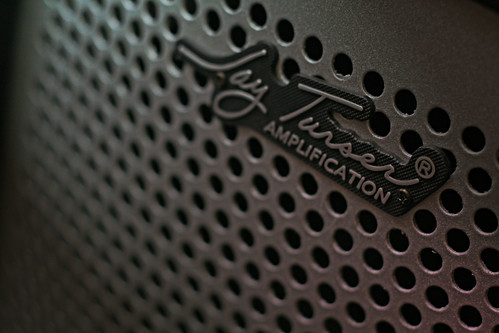
A Little Competition ;)

title=”Colored Amp by n1zyy, on Flickr”>Colored Amp

Okay, so I much prefer Andrew’s. But I woke up this morning and Kyle’s guitar amp was the first thing I saw. “That’d make a good photo,” I thought.

I don’t know what to make of it, though. I always envisioned it as something that would be a good picture at a concert, lit by various stage lighting. In this case, it was lit by light coming in through the window, and the shot would essentially have been black and white.

So I wonder what to make of my modifications. If I told you that I set up two slave flashes, one with a blue gel over it, and one with a red filter over it, and positioned them on opposite sides of the amp, you’d think I was a really advanced photographer, going to great lengths to create a good shot. But I’m a college student with no external flash, much less two radio slaves with colored gels I can slip in. So I used Photoshop to add in some colored lighting effects, and dialed the opacity down to make it more subtle. I also applied some very “broad” sharpening, because the “Jay” was initially thrown too far out of focus. It’s still not nearly as good as I’d like, but the outline’s better.

So the net result, I think, is that it conceivably looks like a shot taken at a concert, or something else interesting, versus something taken of my roommate’s guitar amp on the floor on a sunny morning. But part of me thinks it’s “wrong” to go that far in Photoshop.

Naming

Fark.com reports that a group of people in San Francisco have started a petition to, well… I’ll quote them.

Kennedy had a stadium named after him. Reagan has an airport. Where will George W. Bush have his name emblazoned? In San Francisco, it looks like that honor will go to a sewage plant.

Of course, my understanding is that this is just something one group is proposing, versus a city initiative.

Argh!

All of a sudden my Treo 650 locks up hard when I try to enable Bluetooth. You have to do a hard reset (wiping all data) to get the phone feature to work again. I was able to back it up before doing this, but… What gives? I can live without Bluetooth, but I kind of like it, when, you know, all of the phone’s features work.

Steve, is this a sign?

Write It Out

I’ve seen this suggested before, but only half-believed it.

When you’re stumped by a question, write it out. We’re hosting a video game tournament tomorrow, and I was thinking about scoring. I got stumped by some technical problems with the way the bracket would work.

So I decided to burn my weekly Ask MetaFilter question. Except, three-quarters of the way through writing out the question (in great detail), I realized exactly how you solve the problem.

The thing is, if I sat here and tried sketching out how the bracketing would work, I never would gotten it. For some reason, writing it as a question caused me to be able to answer my own question, in a way that starting at it didn’t.

Seriously, try it next time you come across a tough question. It obviously doesn’t work 100% of the time (“How many escalators are in Wyoming?”) But something about writing it out causes the mind to look at it differently. And sometimes that’ll solve your problem!

Also, an Excel hint… How do you do “Best 2 out of 3?” in Excel? There’s no native function to do it. And if you asked me to write code, I’d overthink it and write some contrived thing that would take the best x of y items. But let’s say that cells A3, A4, and A5 (thus A3:A5) contain the three scores, and you want the best (highest) two of the three. =SUM(A3:A5) - MIN(A3:A5) does it. Best two out of three is the same as “All of them, discarding the lowest.” This doesn’t scale: if you wanted the best six out of eight, it’d be much harder to compute. But here, you’re just dropping the lowest.

Geek

So my building here is one in a “set” of three dormitories. There’s a walkway, and another building on the other side of it. (And the third is to their side.) As I came back from class, I noticed a rope running from a room on the floor above mine across to the room pretty much opposite mine. It was extremely nice out today, so even those of us not creating improvised clotheslines (?) had our windows open.

We took a partial interest in whatever they were up to, but mostly about our business, just periodically looking to see what they were up to. We could also hear everything they were saying. So I sat at my desk working on something or other, when I heard a “roger beep.” I instinctively knew that it was from an FRS radio. It’s one of those silly noises they make at the end of a transmission. (As compared to things like MODAT [.wav] or MDC1200 [.wav], which are useful for ANI.) I’ve only ever heard it on FRS, so I “just knew.”

Of course, merely thinking, “They must be using FRS” because of a sound I overheard wasn’t geeky enough. So without missing a beat, I picked up my ASTRO Saber and switched to the “Zone” I’d created for the FRS band, and threw it into scan mode. A couple minutes later they transmitted again, and the scan stopped on Channel 2. Sadly, they didn’t discuss the actual purpose of the wire, only the difficulties they were facing on one of the ends.

It was tempting to radio back, “What exactly are you guys doing?,” but I didn’t want to blow my cover just yet. And besides, this thing puts out five Watts, ten times the power allowed on the band. (And the deviation/bandwidth is probably wrong, and it’s not type-certified…) Oh, and I think I probably have it set up to send an MDC PTT-ID.

It really concerns me how my mind works sometimes.

Business School

As I’ve mentioned in a few past posts, those of us in business school really don’t think normally. Having found that there are a lot of good jobs in Nashua (versus my previously-narrow search in Boston), I started looking, out of curiosity, at real estate in Nashua. And I stumbled across this place, a home with an attached storefront.

It’s located in a very dense rural area, and seems like it may have a high percentage of renters in the neighborhood. So I thought a laundromat may do well. Of course, you also stock a lot of vending machines. Although labor really isn’t necessary, I’d probably want to employ one person to watch over things, and maybe to do laundry for people who want to drop stuff off, and to help customers who need it. I’ve read that it’s hard to keep good staff, but really, the job requirements are minimal–you have to be able to work a washing machine, be friendly to people, and watch over the store. You’d probably have a lot of free time, too, which could be spent watching TV, surfing the web, or whatever. And I don’t think I could bring myself to pay less than $8/hour or so.

It’s hard to find much information on commercially-available solutions, but a “water recycling” system could help cut costs, too–filtering the “waste water” and reusing it. Additionally, I’d sell plastic “gift cards,” at a small discount. ($50 for $45 or so.) The cards would also help everyone by not being coins, meaning that they wouldn’t have to lug around a pocket full of quarters, and I wouldn’t have to empty huge hoppers of quarters. (Although a lot of coin-based places seem to end up being “closed loops” of quarters–you put your bills into the change machine, get quarters, and put them into the washers or vending machines. So at the end of the week, I go in and move the quarters back into the change machine, and take the bills to the bank.) Selling the pre-paid cards, though, would generate a lot of cash up front, which could be put into a high-yield savings account. If you get a gift certificate for your birthday, how long until you spend it? Especially when it’s a “bulk” item (something you can spent on multiple visits), it may well be six months or longer before you’ve depleted it. Further, gift certificates also get forgotten and lost. Thus, if I sell $5,000 in gift certificates, I might only ever have an expense of, say, $4,500. And that $5,000 is in the bank earning me a decent chunk of interest.

They now make cheap security cameras that do resolutions like 1280×1024, versus the standard 640×480. And with things like ZoneMinder on Linux, it’s easy to set up an excellent camera system on the cheap.

I’d also pull in a cheap cable/DSL line and offer free WiFi for people doing laundry. Hopefully, while waiting for their laundry, they’d also buy some food from the vending machines. (As long as I have someone working there, actually, we could maybe serve fresh, hot food, like hot dogs or pizza!)

And of course, there are benefits to me besides the income. I wouldn’t need a washer and dryer in my home, since I’d have a dozen attached to my home. And I wouldn’t need to buy Internet access, since I’ve already got it at the laundromat. Plus, it’s occasionally a problem to have packages delivered to my house, as no one’s home and they might need a signature. Now I’ve got an employee who could collect them.

Of course, only after developing a killer business plan in my head did it occur to me that maybe I don’t want a home in a not-so-hot neighborood, especially one where I don’t have a driveway.

It’s Florida

What is it with Florida and screwing up elections?

Right now there’s a big debate over what to do with their election results, which officially don’t count, and in which no candidates were allowed to campaign. Hillary did anyway, and, unsurprisingly, won.

Of course, counting the votes is unfair–only one candidate campaigned, and she was breaking the rules in doing so. So obviously, it would favor her. But then again, not counting the votes would be equally unfair–you’re disenfranchising a whole state.

Right now, I suspect that, as with Florida and the 2004 general election, 2008’s Democratic primary is going to be very close. And we’re going to end up with a big fight over Florida, the outcome of which will swing the vote one way or the other.

Except I think we’re at a critical juncture. A united Democratic front can take back the White House in 2008. A bitterly-divided Democratic party, feuding over the nomination, is going to lose. And if we get into a “credentials fight” at the DNC, it’s going to be the latter.

So, from the 49 other states–actually, 48, as Florida isn’t the only one with problems: please, figure out how to hold an election!

The Most Awesome Thing…

…Ever.

Hulu. You can watch TV shows online. In (seemingly, I don’t know the exact resolution) high def. That’s pretty cool. Plus, it’s legal. Oh, and, the most important part: there’s no catch… It’s free. You sign up and watch TV shows.

With shows like Arrested Development, The Office (only 9 episodes right now), House (only 2 episodes), Psych (5), Monk (6), Journeyman (13), I Dream of Jeannie, National Geographic Presents, and…

Alright, you know what? I started listing the cool shows to write a nice, proper review. But the truth is, I really don’t want to write this anymore. I have 8 episodes of The Office, and an episode each of House and Psych to watch. And that’s just of the first four series I’ve listed. Paging through the list of shows to list the ones I love, I realized that I’d much rather be watching Hulu than writing about it.

So sign up and come join me in what might be the single biggest blow ever dealt to American productivity.