In case anyone else is struggling like I am… After you install MySQL on CentOS, it doesn’t seem to want to start… You run mysqld and it barfs up an error.
It turns out that it’s because you need to run service mysqld start instead.
(And if you’re looking for how to install GD2 for PHP, and frustrated because a search of “gd2” in yum turns up nothing… That’s because it’s called php-gd, not php-gd2.)
Ed.: Because the blogs have been slow, and because this is a hot topic, I’ve fudged the date on this to appear to have been published two days later, so it will stay on the main page a bit longer.
It looks like Obama is the Democratic nominee, while Hillary Clinton, the woman who has twice alluded to Obama being assassinated (okay, the first time was a speaker at her event, not her), has conceded that she’d be open to running as his VP.
I’d be happier with an Obama-Richardson ticket, but people are calling Obama-Clinton the fastest way to try to heal the wounds this election cycle saw. In her defense, if she doesn’t get him assassinated, she’d make an excellent VP.
Needless to say, I’ll be watching the news tonight for what may be two very historic speeches: Obama’s victory speech and Hillary’s concession speech. (It seems like it was just weeks ago that Obama gave his “” that was anything but a concession speech, in New Hampshire, which led to .)
The AP story is hot off the press, and many MSM outlets aren’t carrying it yet. Whether that’s because the polls don’t close for two hours, because it’s not factual, or just because MSM isn’t as obsessed with checking Google News as I am remains to be seen.
Update 2: USA Today has a good piece suggesting that, while Obama might do it tonight, it’s still about 30 delegates premature. And they also have this good article on exactly how the AP story was put together.
While I’ve somehow completely eradicated comment spam for the time being here, I’m getting a decent amount on an old page elsewhere on the server that allowed comments. It fell into disuse long ago, so I’ve done some behind-the-scene tweaks to make it more of a honeypot for spammers. They don’t seem to care that no one visits the page anymore. I did a purge of a lot of the spam, before, halfway-through, deciding to keep it as a honeypot. Some of them are replying to threads that don’t even exist anymore. I’d never coded in anything to check whether the parent thread existed, so it’s “accepting” their comments, but they’re not even showing up on the page. And still they come!
Recent words of inspiration from one spammer, right before a set of links to porn:
Your site has very much liked me. I shall necessarily tell about him to the friends.
I beg to differ. My site does not very much like you. While it may smile while accepting your comments, it’s not smiling because it likes you. It’s smiling because it’s assembling a list of spamming IPs, and you’ve just landed on it. Please do, however, tell your friends to spam the page, too.
P.S. – I have deliberately refrained from linking to the page being abused, as I want to minimize its popularity, both to avoid giving the spammers exposure and to minimize the risk of someone leaving actual comments.
Very often, I’ve wondered why TV isn’t carried over IP yet. For something broadcast over the public airwaves, it seems strange that no one makes it available over the Internet. I don’t mean being able to play little snippets and stories. I mean that I’d like to be able to do the same thing I can do with some radio stations: stream exactly what they’re broadcasting.
I don’t have a TV in my room. And frankly, I’d buy a 30″ LCD computer monitor before I spent the same amount on a 30″ LCD TV. But I do have several computer monitors. (In theory, my laptop and two 17″ LCDs, plus two 19″ CRTs, though none of them are hooked up right now.)
I think someone sufficiently enterprising could set something up, though. Think of a MythBox, which has a TV capture card. (Yes, they support HDTV.) It’s oriented towards recording, but really, there’s no reason you couldn’t simultaneously stream it over the LAN. It would require a decent amount of horsepower, but quad-core processors are getting cheap. One of those could easily serve a household. You’d just need enough TV cards to allocate one per simultaneous channel being watched (or recorded).
And then you just build a little webserver into the thing, and let me pull up streaming video from any channel I get over cable.
This comic was pretty funny, and the age/2 + 7 formula got tossed around a lot by my roommates.
Of course, it gives us the minimum age one can date without being creepy. At 22, it’s [(22/2) + 7], or 18. (I, however, maintain that this discrepancy would, in fact, be creepy.)
But what about the upper age limit? The formula itself is silent on this, but we can easily do some substitution to make it work. If the minimum acceptable age (“M”) is your own age (“A”) divided by two, plus 7, we get:
M = A/2 + 7
We typically solve for M, knowing A. However, the oldest person I could date would have my A as their M, e.g.:
22 = A/2 + 7
With this realization, it’s a simple Algebra 1 question. Subtract 7 from both sides and then multiply by two.
Thus, the maximum age one can date is 2(a-7), where a is your age. For me, it’d be 2(22-7), or 30.
What interests me, though, is that this means I’m allowed to go back four years, but forward eight, within the margin of creepiness.
I built a spreadsheet for people aged 1 to 100 showing this and various other statistics. It’s online here as an HTML document. A few interesting trends emerge that aren’t intuitively obvious working with just the formulas:
The formula doesn’t make any sense below age 14.
Age 14 is a sort of ‘identity,’ when you’re first able to start non-creepily dating people, apparently, without breaking any laws of mathematics. At age 14, you can’t date anyone older, nor younger, than 14.
From there on out, every year you age adds 0.5 to the minimum age you can date, while adding 2 to the maximum age. Thus at 22, I can date 18-30. When I turn 23, my new range will be 18.5 to 32. (At age 100, you can date anyone between 57 and 186. Because dating anyone over 186 would definitely be creepy.)
As you can see, the two don’t grow at the same speed; the upper age grows four times as fast as the lower age. An interesting side-effect of this is that this means that, as time goes on, your age becomes radically different than the median age. By the time you reach 100, you’re 21.5 years younger than the median age of people you can date.
Rusty and I were just talking about the recent decision by the Democratic party and how we’re going to count delegates from the two states, which has left both sides somewhat unhappy.
But then we kind of realized that no one is talking about the real issues? I don’t particularly care how we seat delegates. The whole system sucks, and I hope after 2008 is over we can overhaul the way the DNC works. And I kind of had an epiphany: I feel like I’m trapped in this country, a faded emblem that used to be a beacon of prosperity and freedom.
Let’s talk about some things that actually matter.
I paid $53 to put gas in my car yesterday. It’s increasingly tempting to get a hybrid, but they’re in short supply. Not because they’re in high demand (though they are), but because not many are produced. American auto’s only hybrid seems to be the Ford Escape hybrid. (I refuse to count GMC’s “greenest” SUV that gets 20MPG.) A question on Ask MetaFilter today called my attention to the fact that they’re basically impossible to get, with the dealer he went to telling him flat-out that they wouldn’t order one for him. BTW, Ford just announced a $3 billion plant in Mexico.
We are the only civilized country in the world that doesn’t have universal health care. Americans are running into massive debt because they got sick. The typical response, beneath it all, seems to be a survival-of-the-fittest mentality that if you get cancer and go bankrupt paying for your treatment, it sucks to be you. Attempts to reform the system are consistently subverted by cries of “socialized medicine” without ever presenting a legitimate claim, just the catch phrase? (And there’s a good point to be made about how this is costing us huge money in less-obvious areas.)
If you come to see homosexuality as something that isn’t ‘wrong’ or ‘bad,’ opposition to gay marriage seems appallingly bigoted. I really don’t think opposing gay marriage is any different than opposing interracial marriage.
College is $40,000 a year. Schools throughout our country are failing. To quote, well, everyone, No Child Left Behind has left plenty of people behind.
Veterans are returning home and getting next to no support, or staying in ramshackle hospitals. Support our troops! Anyone? Those who oppose sending young Americans—my peers; people I went to school with; maybe me if I was born into a different family—to die in someone else’s civil war are branded as unpatriotic and not supporting our troops by the same people who can’t be bothered to waste money caring for our returning soldiers?
The United States economy is tanking. It probably has something to do with the fact that our schools are being surpassed by countries around the globe, that our post-9/11 xenophobia has resulted in immigration policies forcing college students who come here from abroad to leave our country, and that our health care costs are through the roof.
The thing is, I really love this country. But all around me I see signs of our great nation crumbling. At times I almost feel trapped. Can we please stop focusing on the things Republicans and Democrats disagree on, and instead work on getting things done? We all love America, want our troops to be cared for, want our schools to be the best, want to get treated in hospitals, and want our economy to thrive. Working with two parties seems to keep us from ever getting anything done, because all we can ever do is disagree. But why does it have to be that way? We all want the same things deep down. Can’t we take our different viewpoints and use them to our advantage, crafting solutions that appease both of us?
I was pleasantly surprised by what my little 55-200mm Sigma can do! I’ve noticed that if you’re not exacting in aligning the polarizer, you lose a lot of contrast, BUT it’s very easily fixed in Photoshop. I’ve also noticed that, short of focus problems, most everything is easily fixed in Photoshop. (I’ve stopped thinking of the images out of the camera as the final product, really.)
Shot at ISO 1600, with less noise than I’d expected, even after ‘lighting up’ the shadows a bit in Photoshop. There’s noise if you look for it at high resolutions, but I’d forgotten that 1600 can be quite usable.
As I mentioned at the top of the post, I’ve started doing a lot of post-processing in Photoshop. It’s something I hadn’t really been tuned into until I started doing a lot of photo enhancement, but a lot of images have a sort of ‘haze’ to them. (Shooting through a window, or shooting through a misaligned polarizer, will do this… But some cameras with crappy metering equipment do this on their own.) That’s easily fixed with Levels. Some images aren’t quite as tack-sharp as they should be, which can also be tweaked in Photoshop. Even the best cameras have imperfect dynamic ranges, leaving some details in darker areas obscured, and brighter portions overexposed (“blown out”). So my workflow (that’s a major buzzword right there) is to align images (rotate as needed, and adjust any that have sloping horizons), perform a Shadows & Highlights enhancement (CS2 and newer, I believe, have this feature, which is invaluable!), adjust Levels, and then apply an unsharp mask (I’ve been tending towards Smart Sharpen, 55% over a 1-pixel range, but it gets tweaked as needed.) Periodically I’ll play with Variations to get colors just right, and boost (or tone down, depending) an image’s saturation, but that’s only as-needed.
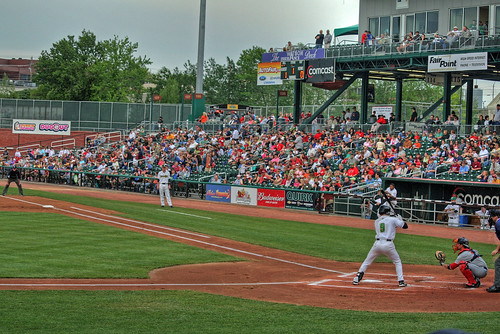
That’s straight out of the camera. Not necessarily a bad picture, though a bit underexposed for my liking. (I’d gotten a batch of slightly overexposed shots, so I set it to underexpose slightly, which ended up being a mistake.) But here it is after 60 seconds in Photoshop:
It’s an okay shot, but I think it’s a case where HDR really isn’t appropriate. It ends up being a very busy shot, and the very bright (very saturated!) colors in the crowd end up drawing attention away from the batter.
I’m also becoming a fan of panoramas. I’m glad Mr. T recommended Windows Live Photo Gallery or whatever it’s called; it’s worked pretty well. This ended up being a GIGANTIC photo (15297×1263 pixels, and that’s AFTER a very heavy crop, since my images didn’t line up that well, leaving huge black areas on the top and bottom). The downside is that there’s really no good way to view it; Flickr’s next size up (if you click through) is 1024×85 — 1024 pixels is a good width, but an image 85 pixels tall is practically useless. After that is the original, which I don’t recommend unless you have a fast connection and a lot of time to scroll around.
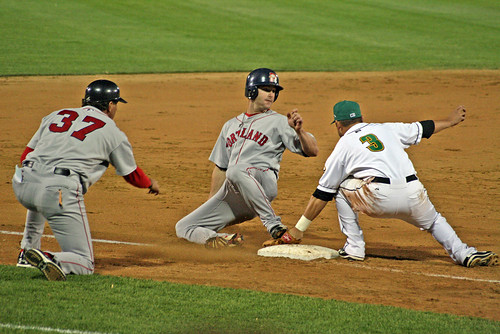
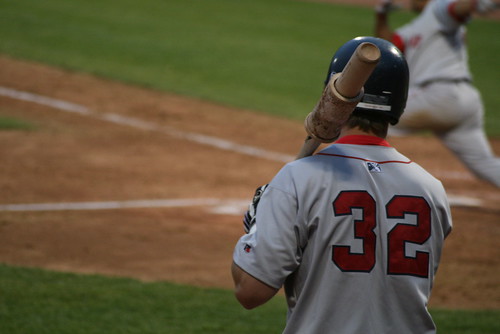
Anyway, it was fun… We left at the close of the 6th inning because it was getting late, but we (Manchester Fishercats) were losing 8 to 14. But I got some good pictures.
I think the best thing about SLRs isn’t their elimination (well, exponential reduction) of shutter lag, nor the support for high ISOs, or even advanced exposure and metering modes. It’s that even at relative high apertures (f/5.6), you can keep a shallow depth of field. Consider this photograph:
(Does anyone know what type of flower this is, BTW?) The photo wouldn’t be half as good if everything were in focus, as a normal camera would have rendered it. But by throwing the distracting (and ugly!) background out of focus, the shot comes out a lot better. I don’t entirely love the depth of field on this one; I wish you could see a little more of the plant clearly (which would have required that I stop the lens down a bit more), but I also wish the background were even further out of focus (which would have required that I open up the lens a bit more). BTW, a little bit of HDR going on here, as it wasn’t the best lighting.
There’s another example. Too shallow, or at least, I should have manually selected the autofocus sensor to use one on the left, so that all the caterpillars were in focus. But the background (green and purple bushes) are pleasantly blurred, keeping your attention on the tree.
Here I totally disregarded the rule of thirds. I like it anyway. The other leaves were pretty nearby, so they’re only slightly out of focus. But again, it draws your attention in closer.
There’s the best example. The trees in the background were across the street, and thus extremely out of focus. The camera focused on the leaves, which are tack sharp.
And now, I’m going to go finish mowing the lawn. There were just too many photo opportunities I noticed… 😉
Although I’m attending a Fishercats game tonight… It’ll be my first time with an SLR there. Let’s see how that goes.