Horror

I’m not a big movie watcher. I probably watch half a dozen movies a year. That might be a high estimate. And probably not more than 10% of the movies I watch are horror movies. But I still like them.

You have to watch scary movies alone in the dark. There’s just no other acceptable way of doing it. So I just watched Disturbia. My parents described it as a modern version of Rear Window. So my expectations were pretty low.

I am now terrified. I’m lying in my bed with the covers almost pulled over my head. My closet door is partially open. I can’t really see in. Someone could very easily be lurking in there with a knife. I kind of want to shine my flashlight in, but that would almost certainly trigger them to come out. I also don’t know if anyone is under my bed. Little kids worry about monster under the bed. I’m worried that Mr. Turner might be under my bed, waiting to plunge a knife through the mattress and into my back as I lie here in utter terror.

I have my cell phone by my bed. I always keep it there since it’s my alarm clock. But tonight it’s so I can call 911 when Mr. Turner tries to kill me. Trust me, I’ll be sleeping with one eye open.

I keep a pocket knife around, as a handy tool. I kind of think I should get out of bed and get that for when he comes to kill me, but I don’t want to leave the safety of my bed.

How absurd is that? I legitimately feel much safer lying in bed, and am exponentially safer if I pull the sheets way up. My body’s natural reaction to someone (potentially) lurking in the shadows of my closet waiting to kill me isn’t to get up and get the knife just out of reach, but to pull some thin covers of me, to the extent that I can’t even see the threat coming. It’s probably the least safe thing you could do, second only to putting on a blindfold and then trying to on an offensive using styrofoam.

I tried rationalizing it. Mr. Turner isn’t real. But… I bet there are people like him in the real world. Maybe even worse. And surely, you couldn’t stick a knife through my bed and kill me, because it’s too thick. (And while a sword would do the trick, you couldn’t maneuver it underneath a bed.) But when was the last time you inspected the underside of your bed? He could easily have cut out a hole so he only an inch of mattress or so remains in one area. And, once I’ve dozed off comfortable that no one is trying to kill me, he’ll plunge the knife through my back.

It was nice knowing you all.

Besides his pasttime as a serial killer, BTW, Mr. Turner just radiated a really, really unlikable personality. He’s played by David Morse. You might recognize him. From House. He’s Detective Tritter. No wonder I disliked him.


Deals

Most people probably like to read the comics in the Sunday paper. I like to read the circulars. Every week there are good deals. But sometimes, there are great deals. And this week, there are several. (N.B. that most of these have rebates attached to them.)

  • $600 buys an HP Pavilion notebook with a dual-core AMD Turion processor, 120 GB hard drive, 14.1″ LCD (“Brightview Widescreen” no less), CD/DVD burner (with “LightScribe Direct Disk Labling”), a built-in webcam, Vista Home Premium, and, get this, 2 GIG of RAM. This is a monster of a machine, and $600 is just insane. [Office Depot]
  • What I think is three reams of (store-brand) recycled paper, $16.99. [Office Depot]
  • eMachines Athlon 3800, 1 GB RAM, 160 GB disk, dual-layer CD/DVD burner, Vista Home Premium. No monitor, but an all-in-one printer/scanner/copier. Not a spectacular machine, but $299.98. [Office Depot]
  • Refurbished HP all-in-one machine, with a card-reader and 2.4″ LCD. I’m not a huge fan of refurbished stuff, but $49.99. [Office Depot]
  • Store-brand 75-pack DVD-R and 25-pack CD-Rs, $7.99. [Office Depot]
  • 300-amp jump starter kit, $19.98 at Pep Boys. Or pay $49.98 for a combination jump-starter (rated at 450 amps) and an air compressor.
  • Lexmark X1240 all-in-one machine (printer + scanner + copier). $27 at Target. Why shouldn’t I buy this? (The fact that I don’t need one is not a valid answer.)
  • $37 at Target gets you your choice of a Uniden 5.8 GHz cordless phone system (two phones!) with answering machine, or a Philips DVD player. Both seem absurdly cheap.
  • 30-pack DVD+R or DVD-R, just $4.99 at CompUSA.
  • 500 GB external Seagate FreeAgent drive (USB 2.0), $117.99 at CompUSA.
  • Intel Q6600, the quad-core 2.4 GHz processor. $289.99. I swear these were $600-900 a month ago.
  • 7-inch LCD digital picture frame (no brand mentioned), $49.99 at CompUSA. At several hundred dollars these picture frames were pretty silly. At $50, it’s a potential gift.
  • An Iomega 1 TB external drive (based on size, it looks like it may be 500+500 or something), for $249.99 at CompUSA.
  • A pack of eight good ol’ Dixon #2 pencils, one cent at Staples. Limit 3 per customer. I stopped using pencils when I realized that I’d just scribble out mistakes instead of erasing them, but 3 cents for 24 pencils…
  • Brother QL-500ec [on Amazon] computer-based label printer, $64.99 at Staples.
  • $750 at Staples gets you a dual-core AMD Athlon 4200+, 2 GB RAM, 320 GB disk, 19″ HP LCD, DVD burner (LightScribe), built-in tuner [no word on HDTV?], 15-in-1 card reader, and Vista Home Premium.
  • $19.98 buys a 1GB Micro SD, xD, or Memory Stick Pro Duo memory card for your cameras. (Or Treos!) If you’d rather 1GB in SD or CF, it’s just $12.98. [Staples]
  • Also at Staples, $69.98 gets you an HP all-in-one machine (apparently not refurbished).
  • 10-ream (5,000 sheet) boxes of paper are $29.99 at Staples.
  • Amazon has this nice OBDII reader for $69.99. Most of our cars are pretty new so we don’t have a lot of problems, but I’m still tempted…
  • Amazon also has my shoes for $30, which is an absurdly good deal. Considering that I’m perfectly happy with them and was going to spend like $90 on a new pair of shoes, it seems silly not to buy them.

I think I’m off to go shopping…

Professor

On our trip to Ghana, we had ten students, two faculty members (who we basically considered students), and two professors.  We tried to pull tables together so that all fourteen of us could have our meals together, but sometimes we’d be lazy and just sit at individual tables.

One morning, I had breakfast with one of the professors and another student. When I sat down, the professor and student were talking about the career track of a professor. I think both of us students walked away convinced that it was something we wanted to do. There are lots of reasons: the pay is good; the job comes with some level of prestige; you get summers off, a month off at Christmas, and Spring Break; but, most of all, I think it’s because I would just enjoy it, and I think I could do a better job than many incumbents.

We were talking about prices in Africa, and someone mentioned the conversion rate, but then added that because of PPP, things were a lot cheaper. When I learned about PPP, we talked about exchange rates, inflation rates, a “long-run equilibrium,” and some complicated formulas that no one understood.

In Ghana, a dollar could buy me three bottles of Coke. In America, a dollar might not even buy me one bottle of Coke. Why don’t discussions of PPP start there? It’s a really simple concept if it’s explained in terms that real people understand.

Accounting is probably the most boring subject I’ve ever taken. The problem with this is that accounting is a fascinating field. Understanding accounting principles helps you know enormous amounts about a company’s earnings. Understanding accounting can help you spot fraud. (Or conceal fraud.) But no professor ever taught it that way.

I think part of the thing is to throw out the textbooks. You need books, absolutely. But textbooks, almost by definition, are boring. This book has good reviews. (Of course it doesn’t cover the whole field of accounting.) You might throw in another book on fraud. Keep the assigned readings short. I think that, if you actually choose an interesting book, some students might actually read it! And maybe they’ll even want to come to class and learn.

Step One

A few e-mails later, it’s occurred to me that I never actually mentioned that I was back from Ghana. I had an incredible time, and we came back right as I was beginning to miss home, so it worked out well. JFK has got to be the worst airport on the planet. I don’t think I saw a single happy person the whole time I was there. (Also, for all of the American, pro-English-language jingoism, you’d think that we might go through the trouble to ensure that the first person that one landing in America has to speak to speaks English?) I have many tales, but don’t really know where to start and don’t want to give too much away so I can have lots of great stories for when school starts.

What I’m actually posting about is The Dangerous Book for Boys. I’d seen it mentioned somewhere and thought that it was a really neat idea. It just showed up on the front page of Amazon as a most-popular selection. It’s hard to tell who the target market is, because it sounds like it’s something that anyone, or at least any male, would enjoy. I think I may have to pick a copy up.

How to Fix the Internet

Okay, so this won’t fix the Internet, but I think it’s high time that what I’m about to suggest is implemented. It’s not exactly a revolutionary idea that I just came up with. It’s what people have been talking about for a decade.

ISPs need to start blocking crap from originating on their network. The only reason, as best as I can tell, that they’ve done anything about spam is that they were getting ‘collateral damage’ when huge chunks of their networks were being listed as spam havens, causing legitimate e-mails to bounce and really irritating all their customers.

Let’s say that your computer gets infected by a virus that causes it to ping flood a given Internet site. What should happen?  I think there are three courses of action. The ISP can do nothing, which is easiest. That’s the status quo. The second option is that some simple firewall rules could detect that your IP was suddenly generating hundreds of ICMP packets a second, have the system automatically realize that something fishy was going on, and remove you from the Internet, perhaps redirecting all your traffic to page indicating what was going on and how to fix it. Or, third, and easiest of all, they could simply firewall off the ICMP attack you were trying.

A lot of the viruses/worms are super-easy to detect. They try to connect to hundreds of computers at once on an obscure port. That alone is something that no ‘real’ user is likely to do. But you can go even further, and have your firewalls do some Layer 7 inspection. (But ooh, that would cost money, and ISPs don’t like that!) They could look at the ‘payload’ of the data and see if it matched the ‘signatures’ of known viruses.

I’m not proposing that your ISP should have people monitor your every move with packet sniffers. I’m proposing that ISPs implement the equipment that would let it detect blatant abuse of the network, which consumes not only their resources but the resources of countless other networks, and stop letting crap go on. Imagine if, once Nimda was known in the wild, your ISP prevented any incoming attacks from reaching you. And that a few of their clients got infected anyway, but that when they tried to use a web browser, all they got was a message indicating that their computer was infected with a virus that was trying to spread with other computers, so they lost their Internet connection until they fixed it, and, oh, here’s instructions on exactly how to do it.

I suppose some customers would be angry. But I think, overall, it’d be worth inconveniencing a few people who couldn’t keep a clean computer anyway.

(Okay, so Nimda was a bad example since it spread so quickly. But it’s not like it was over and done with by the end of the day.)

It wouldn’t block everything. Really clever, malicious stuff would get through. Obscure stuff would get through. Brand new exploits would get through. But it’s just absurd how many attacks go on that everyone was already aware of, and it strikes me as even more absurd that ISPs seem like they couldn’t care less. If nothing else, it’d save them a lot of bandwidth.

Hampton

The Powerball is getting to levels where I play. So I was looking at real estate. I started looking at Portsmouth, which has some nice places. But then I turned my gaze to Hampton Beach, where I noticed something interesting.

There are a ton of hotels for sale. Like, at least half a dozen. Several of them are big.

The pessimist wonders why there are so many hotels for sale, and whether market conditions in Hampton are poor for some reason.

The optimist thinks that six (at least) hotels all up for grabs is a great market opportunity. There are still competitors, so you’re not really a monopoly, but owning a bunch of hotels surely gives better market leverage than owning a single hotel. Other benefits include referrals (“No, we’re all booked for that weekend–but our sister hotel down the street has openings…”), and a sort of ‘laboratory’: you can implement something in one and see how it works; say, a certain type of renovation, price increases, or changes in scheduling. (Plus, there could be economies of scale if you shared services between them, such as buying supplies in bulk and having handymen who serve all locations.)

And $3,000,000 for a 60-unit motel is $50,000 a room. I can only imagine that they need work, but I also imagine that if they were sold as condos, they’d fetch a lot more than $50,000 apiece. Although they’d probably need to be retrofitted for kitchens and the like.

ArmorAll

I was cleaning my car, and figured that, as long as I’m doing the outside, I might as well do the inside. I found a bottle of ArmorAll, so I used that on the interior.

And then I noticed that the label suggests it can be used on tires. So I tried that. They look much better: they don’t have that absurd “really shiny” look that cars in showrooms and car shows have, but they’re a nice deep black now, and make the wheels look even cleaner.

But then, having doused everything rubber and plastic in my car with ArmorAll, I came inside to use my computer. And got to thinking about the Thinkpad’s top. Anyone who’s used a Thinkpad will know what I mean: it’s a really bizarre consistency, sort of rubberized plastic. It scratches easily, picks up oils from your hands if you touch it, and always looks dirty.

So you can probably see where my mind went: can I use ArmorAll to clean/protect the T60’s coating like I do on other plastics?

I figured that the key would be to not use too much, especially since I didn’t know how it would work. So I sprayed a little on a paper towel and rubbed it in. It ended up still looking like too much, so I used a spare cloth to wipe it down, going in circular motions.

I’m on Day 1 so far, but I’m currently very happy with the result. It’s a nice solid consistency, albeit slightly slick. It looks, well, clean, and at least as good as when it was new. The edges are already starting to look a little different (they always have, due to fingerprints where I open/close the lid), but it’s still a definite improvement. I’ll wait a few days and see how it looks then before I decide if this was a good idea or not…

Some Photos

I don’t have any special image-handling code, but here are some photos I wanted to share:

title=”Photo Sharing”>Lemon Trees

That’s a lemon tree! More accurately, it’s about four lemon plants, a few weeks old. Half as a joke, I took the seeds out of a lemon and put them in some soil. About two weeks went by, and we were just about ready to throw the whole thing out, when one little sprout came through the next day. I now have a total of 11 lemon plants.

title=”Photo Sharing”>Lemon Trees

That’s a view from above. I really have no idea how the lemon trees will fare in the winter, although I plan to keep them indoors.

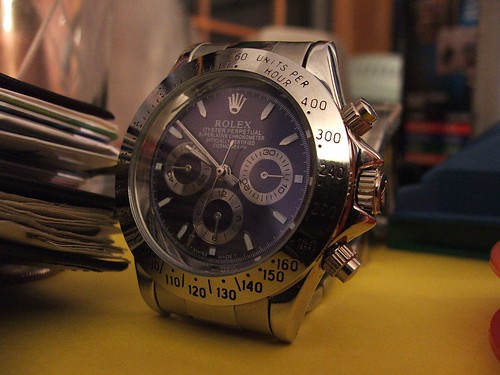
title=”Photo Sharing”>Rolex

Finally, here’s my latest watch. (I have reason to believe it may be fake.)

Ubuntu

Okay, this post is just for those who say that driver support in Linux sucks.

Windows detected that I’d put in a new wireless adapter, but couldn’t find drivers for it. I probably could have found them online, but that’s kind of a catch 22.

I booted the Ubuntu Live CD, and am now posting via the network card Windows didn’t have drivers for.

Digital SLRs

I went out to dinner with my dad, and we stopped by Staples for a few minutes. While he looked at real stuff, I wandered down the camera aisle and was pleasantly surprised to find, for the first time ever, a Canon digital SLR that didn’t have dead batteries.

It had no storage medium, but allowed you to shoot and review images. So here are my first impressions:

  • My current camera is big. This is bigger. However, it’s hard to get a good feel for it because it has an enormous metal anti-theft thing and it’s chained down on top of that.
  • It has an 18-55mm lens. Nothing extraordinary, but 18mm, even on a non-full-frame camera, is awfully wide. 55mm isn’t exactly the 370mm (equivalent) mine goes out to, but it’s still good reach.
  • You get great tactile feedback. You half-press the shutter and the AF sensors being used are illuminated. You press it down the rest of the way and hear a real click from the camera, as opposed to it playing an obnoxious ‘film advance’ sound effect.
  • Since it’s got a real lens on a real sensor, you can play with depth of field. With a nice wide aperture, I took a shot of another camera on the display, and was pleased that everything but what I focused on was blurred.
  • Zooming via lens ring is far, far more intuitive than zooming via W/T buttons.
  • It goes up to ISO 1600, which would be quite handy in low-light situations. I didn’t have time, nor good resources, to see how the images looked at that setting.
  • The flash is ‘intelligent.’ I didn’t pay it much attention at first, but I noticed that it was flipped up after a few well-illuminated shots. It was firing at very low strength for a nice fill-light. It wasn’t a blinding flash that leaves the foreground blown out and the background black as I’ve come to expect from cameras. But then again, $900 of camera had better have a decent flash…

I’m not at a point where I can justify spending $900 on a camera (not including the few grand I’d want to sink into additional, longer lenses), but I can say with certainty that if I did have $900 to sink into a camera, I would have bought it on the spot. (Actually I would have found it cheaper online. But that’s not the point.)