I don’t consider myself a ‘hardcore environmentalist,’ but I’m not sure there’s anyone on the planet who wouldn’t agree that this is absurd.
It could be easily fixed, too, if someone (Indonesian government? UN? Environmental groups?) were willing to pay a bit. Hand out nets, and offer a nominal amount of money for each pound of garbage pulled out of the river. 5 cents a pound? Figure that they can get at least 100 pounds of garbage in a big net, in probably twenty minutes of work. You just need to drag it behind you until it’s full.
I’m sure that pulling all the garbage out of the river won’t instantly cure it of its problems. (Currently, even fish can’t live in it.) But I’m also pretty confident that pulling all of the garbage out of the river would be an improvement over leaving it in…
What’s interesting isn’t so much that Obama won a Grammy, but that he was competing with Bill Clinton for the award, and that both Clintons and Obama have previously won Grammy Awards.
Another interesting trend, mentioned here (among many others) is that Obama wins in a landslide in every caucus. We saw that he can win plenty of primaries, too, but he really shines in the caucuses, which tend to be poorly-attended. Combine that with him having very enthusiastic supporters, the type of people that will spend hours at a caucus, and it’s not too surprising.
“The Votemaster” (at Electoral-Vote.com) has an interesting cartogram up. The Hillary states (pink) versus the Obama states (purple) almost seem to resemble the general 2004 vote: most Kerry states went for Hillary, and most Bush states went for Obama. We still have Wisconsin and Virginia this month, with 23 delegates up for grabs. Texas is coming up in March, and the latest polls (late January) show that Clinton has a lead. Whether this will remain the case or not is to be seen.
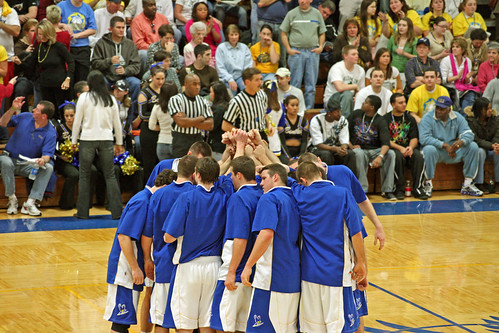
How does that one look? I like to think it passes as a ‘normal’ shot. What’s not evident is that it was underexposed, poorly metered, had a nasty green color cast, and had everything in perfect focus. Tweaking photos in Photoshop requires striking a delicate balance. Too little touch-up and the image doesn’t look that great, and too much and the image looks pathetically artificial.
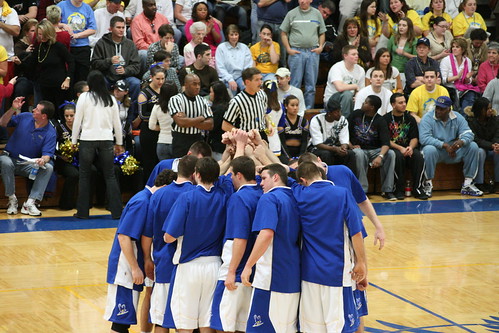
I like to think this one is a good compromise. I used Levels as well as the Shadows & Highlights tool to bring out a lot of the detail that was lost: some areas were too dark (people), and others were too bright (the court). I bumped up saturation and contrast every so slightly (that’s an easy one to take too far), and then used my new favorite Photoshop tool, a ‘smart selector,’ which let me easily select the crowd, and nothing else. It worked remarkably well at letting me not get any of the players or the court. With that, I applied a slight Gaussian blur to the crowd, to throw them a little bit out of focus. It’s what it should have looked like anyway, had it been shot with a faster lens.
Here’s the same shot straight out of the camera. You can see that it’s not really bad, and, side-by-side, it actually look a little more “natural.” But the players are a little too pale, the crowd is a little too distracting, and so forth.
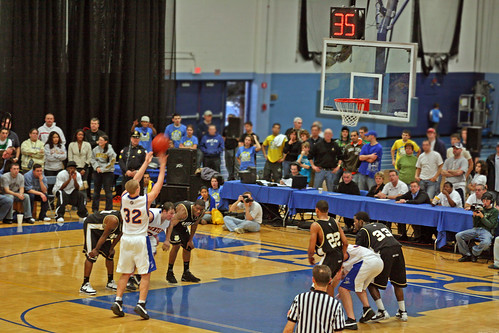
At a glance, this looks like a decent photo. Your eyes should be drawn right to the player as he makes his shot (I love shooting a camera with negligible shutter lag!) (The motion blur on the ball which looks kind of cheesy to me is actually legitimate.) The players, the rim, and the backboard all look nice and sharp. But if your eyes wander the crowd, you can quickly see that my attempt at a few tiers of Gaussian blur were amateurish. Having stuff like the open doors and scaffolding in the back of the gym is distracting. Again, had I been shooting a nice 200mm f/2.0 (not yet released, much less within my budget), it would have been thrown out of focus. But I was shooting with a lens at f/5.6, leaving stuff like that remarkably in focus. I started by selecting all the background junk and applying a Gaussian blur, but to mimic real life blur gets complicated in this setup. I wanted to throw the fans near the court slightly out of focus, but let the doors and walls be further blurred. This required multiple tiers of blurring, and left some strange effects. You’ll notice a few people with bodies that are mostly in focus, but heads that are exceptionally blurry. With a little more time, I could probably improve on this, but this was one of my first attempts at working seriously to manage background blur, so I instead offer it, with its myriad flaws, as an example.
A lot of people (myself included, until recently) are really confused by the discussion of delegates and superdelegates and all that. They refer to the complex manner in which the Democratic Party selects its candidate.
Normal delegates are much like people in the Electoral College system, except that the Democratic Party awards them to a proportional vote: if Obama gets 60% of the votes in a state, Obama sort of gets 60% of the delegates. (It’s actually more complicated, and is awarded by precinct, but I digress.)
The other element is superdelegates, which is a bit of a made-up word referring to “PLEOs” — Party Leaders and Elected Officials. The Wikipedia page Superdelegate gives a helpful explanation. They include DNC members and current governors, senators, represenatives, past and present Presidents/VPs, and a few others. (Thus Bill and Hillary Clinton, and Barack Obama all count as superdelegates, as does Bill Richardson, and probably some others.)
The theory is that these people are more experienced and less subject to whims, although the system has been rightfully criticized as being anything but democratic, giving a small cadre of people enormous sway in the process. There’s a list of all the current superdelegates. It’s on another site in a more organized form, but is split up into multiple pages, and it includes those who haven’t yet endorsed a candidate. You can also view superdelegates supporting Obama and superdelegates supporting Hillary.
I was thinking last night about solid-state drives. In their current form, they’re really not that much faster in terms of throughput: a decent amount are actually even slower than ATA disks if you measure them in terms of MB/sec throughput. Where they shine (100 times faster, at least) is seek time, though. So where they’re ideally suited for in a server environment right now is something with lots of random reads, where you might find yourself jumping all over the disk. For example, a setup with lots and lots of small files scattered across the disk.
Many implementations of a database would be similar. Something like the database for this blog will have a lot of sequential reads: you’re always retrieving the most recent entries, so the reads tend to be fairly close. But there are lots of ways to slice the data that don’t result in reading neighboring rows or walking the table. (And what really matters is how it’s stored on disk, not how it’s stored in MySQL, but I’m assuming they’re one in the same.) Say I view my “Computers” category. That’s going to use reads from all over the table. Using a solid-state disk might give you a nifty boost there. So I think it’d be fun to buy a solid-state disk and use it in an SQL server. I wager you’d see a fairly notable boost in performance, especially in situations where you’re not just reading sequential rows.
But here’s the cool link of this post. I’m not sure exactly what goes on here in a technical sense, but they use solid-state drives, getting the instant seek time, but they also get incredible throughput: 1.5GB/sec is the slowest product they offer. I think there may be striping going on, but even then, with drives at 30MB/sec throughput, that’d be 50 drives. The lower-end ones look to just be machines with enormous RAM (16-128 GB), plus some provisions to make memory non-volatile. But they’ve got some bigger servers, which can handle multiple terabytes of storage on Flash, and still pull 2GB/sec of throughput, which they pretty clearly state isn’t counting stuff cached in RAM (which should be even faster).
Like most enlightened geeks, I love freeze spray. Err, canned air. The stuff you use to blow dust out of your computer’s fan. It’s very handy in that use.
But turn it up side down and you’re blowing something cold enough to give you frostbite. This is the off-label use, and it probably accounts for a three-quarters of what freeze spray–canned air, I mean–is used for. You can harass friends (this is actually pretty dangerous), or deal with misbehaving components. My external hard drive, which has been acting flaky, is running extremely warm, to the point that I worry I might burn myself if I touch it again. So I hit it with some freeze spray. (This is probably not sound practice: I have a feeling hard drives don’t like going from 110+ degrees to -30 in a second’s time. But then again, a short blast of freeze spray doesn’t do much but lower the temperature slightly.
The real problem, though, is inhalant abuse. I’m really not sure why people would do this, as it’s so incredibly useful that you’d have to already be high to think it was a good idea to waste it. But companies have started adding a “bitterant.” I know for two reasons. The first is that they mention it on the label. The second is that the bitterant floats around the room. After cooling down the hard drive, I had a disgusting bitter taste in my mouth. So now, as a legitimate user of their product, I’m trying to find ways to get it without bitterant. Because it leaves me disgusted every time I use it.
I didn’t think it could be done, but I just got choked up watching a music video on politics, the .
Yes we can heal this nation.
Yes we can repair this world.
Yes we can.
We know the battle ahead will be long, but always remember that no matter what obstacles stand in our way, nothing can stand in the way of the power of millions of voices calling for change.
I’ve got to get up early in the morning, so I’m going closing down early. A summary of tonight.
For the Republicans, I can simply say that McCain was the winner tonight. This isn’t to say that he’s won the official nomination, just that he won most states tonight.
For the Democrats, results were all over the place, and varied.
Hillary Clinton took:
California (my projection)
Arizona
New Jersey
Massachusetts
New York (57% to 40%)
Tennessee
Arkansas (73% to 24%)
Oklahoma (55% to 31%)
Barack Obama took:
Utah
Alaska (my projection)
Colorado (2:1)
Idaho (by a huge 80% to 18% per CNN)
Minnesota (2;1)
Connecticut (close! 50% to 47%)
Kansas (73% to 27%)
North Dakota (61-37%)
Alabama (fairly close)
Delaware (fairly close)
Illinois (65% to 33%)
Georgia (66-32)
And some are too close to call right now:
New Mexico (a weak Hillary lead, but only 1% is in)
Missouri: with 98% reporting, they’re neck-and-neck in both parties
I’m biased (I’m posting this wearing an Obama T-shirt, on a laptop with an Obama sticker on it, with an Obama sticker in my window), but I’d say the winner of the night was Obama. The polls I’d seen left me expecting Hillary to take most states, but I was confident that the way we award delegates would keep Obama in the running. Obama has taken the majority of the states, some by a surprising majority.