From the “Spontaneous Song Recommendations from Genres I Don’t Normally Listen To” category: I’m suddenly a big fan of Allein Allein by Polarkreis 18, which I’d classify as European electro-pop, which may or may not be a real musical genre. For what it’s worth, I never watch music videos, so the Youtube link is just for the audio. It doesn’t seem worth watching anyway.
A quick bit of Googling suggests that “allein” is German for “alone,” and the refrain, “wir sind allein” translates to “We are alone.” The song is catchy and upbeat, though.
Actually, as long as I’m making spontaneous song recommendations, by Carbon Based Lifeforms is among the best songs you’ll never hear on the radio. This one is apparently a cross between the “Ambient” and “Chill-out” genres, the latter being something I never thought was a genre at all. Everything by Carbon Based Lifeforms makes great background music while working, especially if you’re trying to concentrate in a noisy office.
The latter is available on iTunes. The former is only available on iTunes through what appears to be the German equivalent of a Now CD. (Which is an interesting listen.
I didn’t want to post this at the time, since, in the back of my mind, I couldn’t help but think about the guy who tweeted every step of his vacation and came home to find that the burglars found that information quite helpful. But now I’m back, robbers, so don’t get any ideas.
We rented a house right on the water, a salt water river on the Cape.
We were able to put our kayaks in and go. If you’re like me and most of your exercise comes from typing all day long, it turns out that kayaking, especially against the current, is a pretty good upper-body workout.
The beach behind the house was overrun with Fiddler crabs, an unnatural species of quarter-sized crabs where the females have two little claws, and the males have a normal claw and then a giant claw. They flee when humans come near them, though, so they weren’t much of a bother, just a perpetual curiosity.
The owners were apparently dog lovers; none were in the rental home, obviously, but a bronze (?) black lab stood watch over the water, which gave lots of great photo opportunities.
For reasons I couldn’t even begin to explain, I spent a while photographing weeds amongst wildflowers and asking the experts on Flickr to identify them. I see the above plant everywhere; it was identified as goldenrod that hasn’t flowered yet. And as Wikipedia points out, goldenrod is not an allergen, even though it looks like it would be miserable.
Blue Herons (and, not photographed at all, ospreys) make me wish I had a longer lens, though. But it turns out that most 400mm+ lenses are in the $1,000 price range.
(This blog post was pretty hacked together. But the main page was about to be blank.)
Many of the cars are assembled in the US, at least partially. And even for cars wholly made overseas, we benefit. The foreign ship full of cars made from foreign parts by foreign workers will sail into a US port. The workers on the ship buy goods from US merchants while in a US port, and the ship pays fees to unload in US docks. American workers unload the cars from the boats, and load them onto American trucks, driven by Americans who probably went to a truck-driving school in America. They drive to American car dealerships, where Americans unload them, detail them, and sell them. American marketing firms promote the cars on American television, American radio, and American newspapers.. Americans come buy them, probably having some American soda or American bottled water while looking and sitting on American-made furniture. In the end, they choose a foreign-made car, and pay the American dealership.
Maybe the US gets to keep a little more of the pie if you buy an American car, but if you buy any car in America, you’re helping the American economy. And don’t even get me started on service…
(Oh, and GM, Ford, and Chrysler come in first, third, and fifth, respectively, in terms of new sales under the program. The program has moved 184,304 cars off of the lot in a week’s time, apparently.)
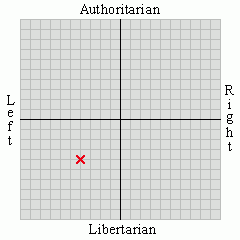
Does anyone else find themselves pathologically incapable of answering multiple-choice opinion questions? I just tried taking the “Political Spectrum” quiz that I keep seeing on Facebook. I can’t get past question 3, though:
In nearly every instance, the free market allocates resources most efficiently.
In a considerable majority, I agree emphatically. In a small-but-really-important minority of the time, the free market does a horrendous job, and it’s very important for government to intervene to keep the train on the tracks.
The question sort of appears to say what I’m saying, but not quite. If I agree, it sounds like I’m saying that laissez-faire economics almost always works. The exceptions are too notable to brush off, though. But if I disagree, it sounds like I support a Communist-style central control model, which would be even worse.
So instead, I answered “Neutral” and marked the issue of extremely low importance. That’s not right, either: it seems to make it seem that I’m apathetic about the economy.
I think I tend to spend way too much time looking into how questions will be interpreted, and how they might impact the results, rather than answering from my gut. I didn’t do it on standardized tests since it would muck up the works, but on tests in school, I periodically found myself writing comments on multiple choice questions. On one Physics exam or something or the sort, I wrote in, “This assumes the question refers to the atmosphere on Earth,” which not all questions did. Multiple choice questions shouldn’t leave me making assumptions.
Consider Question 50: “A person’s morality is between that person and God only. Government should not get involved.” I really, really want to write in, “If, and only if, their behavior does not harm others.” If we’re talking morality in terms of what someone does in a bedroom or the type of language they use, government should absolutely be kept away. But I tend to think that not going around lopping everyone’s head off with a machete is moral behavior, and the government is rather involved in restricting that practice. Government should enact laws that keep people safe. Many of those laws may reflect the society’s morals, but only to the extent that they actually serve the best interest of the people.
I’d be interested in watching someone else take this. There are some questions where I waffled. After seeing some of the blatant lies presented by some political activists on their talk shows, “Radio stations should be required to present balanced news coverage.” sounded like a good idea. I leaned towards yes. But “balanced” in whose eyes? The far-right hated “MSM” (mainstream media, a favorite target of extremists on both sides, and maybe people with brains on both sides, too) because it did nothing but attack the President and ignore their conspiracy theories about Obama being a Satanic Freemason. The far-left hated the same MSM at the same time because it wasn’t critical enough of the President and the wars, and because it kept showing Obama with the caption “Osama bin Laden.” You can’t really legislate “balanced.” Plus, there’s that whole First Amendment that suggests that this effort would be incredibly unconstitutional. So I spent a long time mulling this survey question. Others (“If our leader meets with our enemies, it makes us appear weak.”) had intuitive answers that I chose without any thought, because I already knew the answer.
And interestingly, I’m finding that the questions that hint at contemporary political issues are ones that I mark as being very important, while the Ivory Tower questions are of low importance to me.
Of course, other questions just stump me. “It is wrong to enforce moral behavior through the law because this infringes upon an individual’s freedom.” Not killing people is moral behavior, and a law against that doesn’t trample individual freedoms. On the other hand, things like laws against same-sex couples or interracial marriages were sometimes thought of as “morals,” and those definitely don’t belong as laws. It’s too vague of a question to really be able to answer.
And here’s a perfect example of the questions I think too much about: “Whatever maximizes economic growth is good for the people.” I ended up disagreeing strongly, because economic growth shouldn’t be the primary driver. (For example, people dumping nuclear waste into the water supply would save companies lots of money on waste disposal and lead to economic growth, but it would kill people in the long run. And probably short term, too.) But I worry that this answer leaves open the implication that economic growth is not important, and that I’m more focused on adding regulation than having growth.
Oh, and “The lower the taxes, the better off we all are” is another one. On some level I agree, but I think the real metric is what we’re getting for those services. If we had anarchy, we would have a 0% tax rate, but perhaps absolute mayhem, too. I can’t answer this question as-is.
I get the psychology of why some questions are asked, but they’re not really about politics. “It is a problem when young people display a lack of respect for authority.” I think it’s normal and I think it perhaps ties into a healthy distrust of authority, more or less an important principle of democracy. But what does it have to do with politics?
I bought my brother a new camera. His never seemed like a premium one, but recently took a turn for the worse. My mom’s is nearly ready to kick the bucket, too.
I initially went into Best Buy and looked. And they don’t have any meaningful data on the cards. The main difference between cameras, as far as they care, is resolution.
My camera is apparently 10 megapixels. I’m not actually sure, because it’s unimportant to me. All I know is that I have it turned down to “Medium” resolution. My brother’s new camera is 9 megapixels, so I turned his down to Medium, too. Down at about 6 megapixels, with a new 2GB SD card, he can take over 1,000 shots. On the computer, the images still require zooming around the screen to see in whole. So really high resolution is essentially a bother to me. Camera makers, are you listening?
But it seems they aren’t pouring all of their resources into megapixel wars. Most (!) decent point-and-shoot digital cameras now have gyroscopic image stabilization on the lenses. I don’t know how it compares to the IS/OS on a $2,000 lens, but it’s surely better than nothing. ISO sensitivity has really expanded, too: a considerable number of mid-range point-and-shoots go to ISO1600 or further. Until recently, this was pretty much the exclusive province of much pricier cameras. More than a few have HD-range (usually 720p) video recording, and some have amazing zoom, sometimes along the lines of 35-600mm equivalent.
The things in that paragraph get me excited. They’re the neat, advanced technologies. Bumping up your megapixel count is not.
When you build a piece of hardware with a web management GUI, you’ve got to set a default password. Otherwise no one could get into it.
The problem is that it seems not many people bother to change it. If you know the model of the thing you’re trying to connect to, there’s probably a greater-than-50% chance that you can Google “modelname default password” and get in. Things that people might not normally think of logging into, like VoIP phones, network printers/copiers, and network infrastructure, are generally left wide open.
There’s a fairly easy way to solve the problem, though: make the default password be the device’s serial number. This isn’t infallible, since you know the password will fall within a certain range, but it makes getting in much harder. For those who want to set the password, they need only see the big label saying “Serial Number / Default Password: ABC123XYZ” or read the manual. And for the 75% of people who never bother, they won’t be insecure by default.
As an alternative, for things that require setup before they work, demand that a password be set before networking is enabled. The problem with this is that most people will probably use “password” to get past the screen, with some thinking “I’ll set that later, but for now I want to get this up and running,” and most never thinking twice.
At least half the time I’ve got a polarizer on my lens, it does nothing. In a few cases, it does harm, by letting in a bit less light. But here’s an example when I was surprised by the difference:
I really love Markov chains, largely because they often produce text that resembles intelligible text just enough that we try to make sense of it only to realize that it’s absolute nonsense.
So I find Garkov to be sheer brilliance. It takes drawings from old Garfield cartoons and generates text using Markov chains. And comics are the perfect medium for this because they rarely make sense to me anyway.
When I heard the Gates-Crowley thing, I pretty quickly came to the conclusion that it was a petty squabble that didn’t seem to involve race. I stopped caring. I don’t know who thought to ask the President what he thought about the borderline-justified arrest of someone for disorderly conduct in their home. But this ridiculous story just won’t go away.
I haven’t — and won’t — taken the time to read it, but it’s apparently turned into a multi-hour liveblogging session for major news outlets, complete with coverage of protests, allegations of sexism (the female 911 caller, who gave her tearful speech about the emotional anguish that ensued, was not included), and even news coverage about the absurd level of news coverage.
There’s a big movement in software development to do rapid release cycles. We tend to release every two weeks. If we ahve major work to do, we can expand the window, and sometimes we have just a small sprint and code, test, and release in a week.
Software, be it a simple website or a complex platform, is never done, it seems. You draw a deadline for a batch of features and release them. The next time around, you fix the bugs the last release introduced that your QA process missed, introduce some new features, and probably slip in a few new bugs.
Why do we do this? Why do we need patches and updates? We bought a fairly high-end toaster a while ago. It’s sat in our kitchen for a few years making toast. (Err, making many pieces of toast on many occasions, not spending several years making one piece of toast.) There have been no updates or patches or service packs. It has zero bugs and no security vulnerabilities.
I started thinking about how you’d write code like that. And my conclusion is that you’d have to stop “rapid iteration.” At some point you have a feature freeze, and then you spend months testing, and fix every single little bug, even the, “The bug might affect 2 users ever, but the fix has the potential to break some core functionality in subtle ways…” ones. You’d spend a lot of time making trivial fixes, and a lot of time testing against unlikely uses.
A big problem we find is that we can easily test functionality, but that the real world does things we would never try. People try to stuff bananas into toasters in some cultures and they jam. People bring the toaster to Europe and plug it into a much higher voltage than expected and it blows up. Some lunatic has his outlets wired for DC, and the toaster short-circuits. When you use the toaster inside a cryogenics freeze locker, it never gets the toast warm enough. Some of these are so ludicrous that they’re not worth fixing, but others are legitimate uses that no one ever considered. And yet, somehow, toaster makers never run into these problems. There’s a pretty well-defined set of conditions in which a toaster should operate, and they’re tested in all of them.
But the big thing with the toaster is that you know that it’s got to just work, because you don’t have the option of pushing out a patch release. If people run into bugs with their toaster, they’re going to return it and use the money to buy something from a competitor. They won’t submit a bug report or wait for a patch.
I don’t think this process is going away, but it’s something I find interesting to think about. If you only had one shot to get it right, how would things be different? Do rapid release cycles just make it too easy to release imperfect code?