It’s a Game, Sam

Tonight we toured Waltham’s 911 center. They told us to take the elevator up, so all 14-ish of us climbed in. The doors shut behind us, and then… Nothing happened. At all. We started joking about how funny it would be if we had to call 911 to tell them we were stuck in an elevator… in their office. But as the time passed, the joking gave way to a fearful realization that nothing was happening.

A minute later the doors randomly opened and we decided it would be best to take the stairs.

They showed us their dispatch interface… It looks like it’s Java-based, although it didn’t have the stereotypical ugly Swing GUI. The interface was modeled a lot like a mail application: a “tree” on the left, and two panes on the right. The left tree had three categories: Unassigned calls, Active calls, and Closed calls. It’s kind of neat, though: they have a dedicated calltaker, and a couple dispatchers (who answer calls if the primary calltaker is busy). So as he talked to us about how the system worked, we’d watch stuff pop up in the Unassigned category, and a timer would start. With any luck, it’d get moved into the active category in a matter of seconds, denoting that units had been dispatched. They had about half a dozen actives at any given time. Some lasted a few minutes: a traffic stop would pop up and close a few minutes later. Others were much longer-lasting. A call to check the well-being came in as he was talking, so he clicked on it to show us how things worked.

It opened the details up in the main two panes. It showed the address, written directions, and other various stuff. Below that was a scroll list with all sorts of entries, essentially notes each person entered. A few lines from the call-taker: “[Name] hasn’t been seen since Friday” and stuff of that nature. Some of the notes are automatically added. One looks up gun permits at the address. This one was an apartment complex, and we saw the classic message, “Too many gun permits to list.” (But clicking on the address pops up a web browser page listing every single one.) Another note adds, “3 prior calls at this address” or something of the sort.

Below that was a list of every officer dispatched, color-coded to show their current status. We visited an ‘older’ call to show more, and it showed an ambulance and fire engine which had cleared, and a couple officers still on scene. We didn’t go into it, but the buttons suggest that the system will permit the dispatcher to automatically determine which units to dispatch. (There’s also a “Roster” menu item he showed, which lists every single officer, the sector they’re patrolling, and their current status.)

I’m also impressed at how advanced some of their other stuff is. It’s nothing new for every call to be logged, along with all radio traffic. But what is new, at least to me, is for it all to be stored on a computer with a little GUI. The other day I was at Campus Police researching police log entries, and the dispatcher took a (very low-priority) call. An officer was asking about some specific detail, so he just clicked a few things on the computer and played back the call. On the radio side of things, in addition to displaying unit IDs, everything gets logged to disk, too.

He also talked about the psychological aspect of the job, which was actually quite interesting. He had some training material which consisted of past calls (not sure whether they’re from the department or not?). In one, he plays back a female caller who’s screaming and wailing. You hear a passing allusion to a gun, and then get an insanely detailed description of a car, and then more screaming. Thirty seconds into the call, he paused it. “So what’s this call about?” We collectively shrugged our shoulders. He kept playing, and the dispatcher finally asks if someone is hurt. We get a no, and more information about the car. Two minutes go by, and we’re still not clear what’s going on. He stops the clip at that point, and talks about how one of the most important things they do is taking charge of the call.

Then he switches to another one. It starts off the same way–screaming. But the dispatcher here is much better. “Calm down, I need you to tell me what happened.” We get that someone was stabbed, and more screaming. “Just send the police! Send the police!” “Ma’am, they’re already on the way. Who is stabbed? Who else is there?” The victim is named (not that the name is what they needed right then, but I digress). The dispatcher prods a little more about the woman’s condition, and then adds, “Can you go check? Is anyone else there?” “Yes, her husband. He’s screaming.” “Are you going to be in danger if you go check on her?” “Yes. He has a knife!” It’s a neat example, because it really changes things. It starts off sounding like a simple medical call, and the caller utterly fails to mention the guy running around with a knife until the dispatcher prods him for enough details. The first officers arrived about 90 seconds after the call came in, and they show up already knowing exactly what they’re facing.

I’m left thinking that some of these skills are things that could probably be applied elsewhere. All too often we rely on what other people say and do, when it’d really be better to take control over the situation. As a mundane example, this type of thing happened all the time at work, when people would come up to me with rambling stories and questions. So rather than directly answering their questions, you take control of the call. “Do you have a waiting list?” lead me to ask about the size of the group. And from there, I’d either tell them we had no list and make a mental note that we had a group coming in, or I’d tell them we did have a list, but the fact that I’d already asked about the size of their group somehow made them seem more receptive to me taking putting them on our waiting list, as opposed to them not coming in.

The whole dispatching thing is vaguely reminiscent of games, though. Rather than deciding where to place a teleporter and sentry gun in TF2, they’re deciding what police cars and fire trucks to send to a given location. (He described it as something vaguely like chess.) Rather than being a “shoot ’em up” game, it’s a strategy game.
Problems

Here are the types of things my mind picked up on today that no one else on the face of the planet would notice, much less care about:

  • mot.com (MOT is Motorola’s stock ticker) resolves to 192.168.0.110, a non-routable internal IP.
  • Doing a traceroute from here to mot.com, it goes through six routers (four at school, two upstream) before they start dropping packets. Every single router, in my mind, should be checking for impossible conditions like that and dropping packets. But, if nothing else, our edge router should do this filtering, as should the first upstream router.
  • One of Waltham’s firefighters transmits a sidetone when he keys up, in addition to his MDC data. This is a weird problem. (What’s supposed to happen is that the radio transmits a little data burst at the start of each transmission, identifying his radio. The exchange takes about 200ms, so, while the radio transmits this, it beeps at the user to indicate that they shouldn’t start talking yet. When it stops, it starts transmitting his audio.) In this case, the sidetone and data burst are both getting transmitted.

School

For reasons that even I don’t understand, I find myself thinking a lot about improving schools. And yesterday was one of those joyous experiences where several different thoughts suddenly overlapped, forming something new.

One of my professors is an adjunct professor who teaches at several different schools. And she was talking about how it seemed to her that a decent number of prestigious schools focus too much on theoretical and abstract concepts, but no so much on real-life applications. This nicely sums up one of the areas in which I’d like to see grade schools improved.

  • Gym class was universally an utter waste of time. I suppose it got me moving a little bit. But watching football or basketball on TV, I realize that I still don’t understand the finer points of the game. How come this never came up in gym class? And, perhaps more significantly, I’ve been exercising a bit. I lift weights a few times a week, and am looking forward to nicer weather so I can take up jogging again. (Yes, I should just go to the gym and use a treadmill. But it’s not the same.) Why didn’t I do this in gym class? Why did we spend so much time on badminton? Why is there an “n” in the middle of badminton?
  • I can’t speak for others, but trigonometry was among my least favorite classes ever. Furthermore, I’ve never applied it anywhere. The only time it came up in subsequent classes was when we integrated trigonometric functions, and at that point, no one had any clue what we were doing anyway. But why not replace a math class with zero practical applications with a finance course? Not until I took a finance course here in my sophomore year did I truly learn about things like compound interest and the time value of money. Every person in America needs to know this. You have $1,000 sitting in your bank account. How much will you make if you put it in a one-year CD at 4.25%? And you graduate and go to buy a $250,000 condo, taking out a 30-year mortgage. What will be your monthly payments at 6% interest? What if you get 4.5%? What if you get stuck at 8%? And, when you’re done with that, how much do you pay over the lifetime of the mortgage? (Hint: at 6% annual interest, you pay almost exactly $1,500/month, for $539,000+. That means that your interest is more than 100% of the principal.) You can bring up usury laws, and the fact that national banks, et alia, got themselves exempted from them, and segue into credit cards. Why did no one teach me to balance a checkbook? (Okay, it’s easy. But still…)
  • I want to learn either the guitar or the piano. And I suspect that, if you went to middle or high school, you’d find lots of people who shared my interest. What the heck happened in music class? How did I pass music class without understanding how to read music, and without being able to play anything other than the recorder in 5th grade?
  • What are geography classes teaching people? Why, when I graduated high school, did I still have no clue where Iraq was on the map? Similarly, what the heck happens in  civics and such? Why wasn’t I made to read the Declaration of Independence? Why don’t I know the Amendments cold? I think I should be able to yell “14th Amendment!” to any high school graduate and have them talk about its exact meaning, including due process and equal protection. 22nd Amendment? What President was it enacted in response to? When (ballpark) was it ratified? What states refused to ratify it? (Hint: Massachusetts was one of two.) What’s required to add a Constitutional Amendment?
  • Why are we so reliant on calculators? Last semester we were looking to bring a Presidential speaker, and contemplated opening it to the public to make sure we filled the crowd. A friend pulled out a calculator. “If we charge $5 a ticket, and get 100 people…” He plugged the numbers in. “That’s $500 to defray the costs.” Not until I called him on what he’d done did he even realize the absurdity of using a calculator for 5 x 100. But it’s not that he’s stupid. It’s that we’re all so dependent on them. All the time I’ll start to plug some numbers into a calculator and solve it in my head before I finish typing it in. I think higher math classes need to give Math Minutes again. The kids might think you’re nuts for doing it in calculus class, but it’s necessary!

Pollution

I don’t consider myself a ‘hardcore environmentalist,’ but I’m not sure there’s anyone on the planet who wouldn’t agree that this is absurd.

It could be easily fixed, too, if someone (Indonesian government? UN? Environmental groups?) were willing to pay a bit. Hand out nets, and offer a nominal amount of money for each pound of garbage pulled out of the river. 5 cents a pound? Figure that they can get at least 100 pounds of garbage in a big net, in probably twenty minutes of work. You just need to drag it behind you until it’s full.

I’m sure that pulling all the garbage out of the river won’t instantly cure it of its problems. (Currently, even fish can’t live in it.) But I’m also pretty confident that pulling all of the garbage out of the river would be an improvement over leaving it in…

This is How We Do

I finally got around to processing some of the pictures I took this past weekend. I wanted to share a few.

title=”IMG_1184 by n1zyy, on Flickr”>IMG_1184

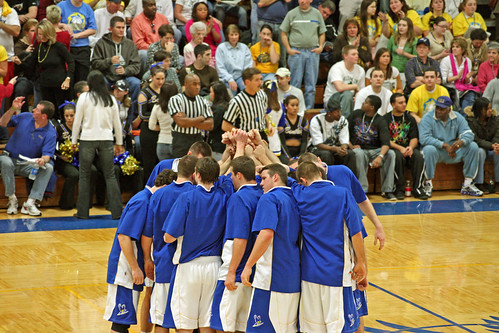
How does that one look? I like to think it passes as a ‘normal’ shot. What’s not evident is that it was underexposed, poorly metered, had a nasty green color cast, and had everything in perfect focus. Tweaking photos in Photoshop requires striking a delicate balance. Too little touch-up and the image doesn’t look that great, and too much and the image looks pathetically artificial.

I like to think this one is a good compromise. I used Levels as well as the Shadows & Highlights tool to bring out a lot of the detail that was lost: some areas were too dark (people), and others were too bright (the court). I bumped up saturation and contrast every so slightly (that’s an easy one to take too far), and then used my new favorite Photoshop tool, a ‘smart selector,’ which let me easily select the crowd, and nothing else. It worked remarkably well at letting me not get any of the players or the court. With that, I applied a slight Gaussian blur to the crowd, to throw them a little bit out of focus. It’s what it should have looked like anyway, had it been shot with a faster lens.

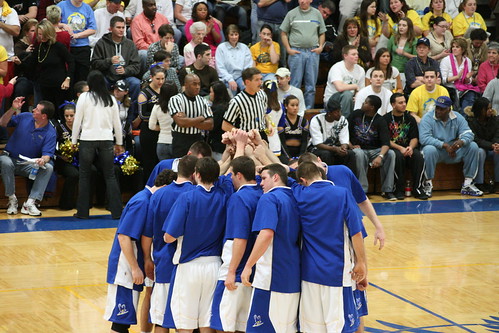
Here’s the same shot straight out of the camera. You can see that it’s not really bad, and, side-by-side, it actually look a little more “natural.” But the players are a little too pale, the crowd is a little too distracting, and so forth.

title=”No Post-Processing by n1zyy, on Flickr”>No Post-Processing

Now here’s another one I took:

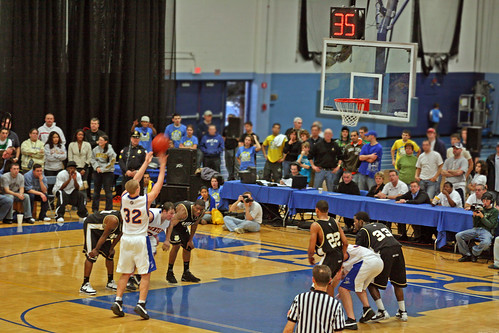
title=”The Shot by n1zyy, on Flickr”>The Shot

At a glance, this looks like a decent photo. Your eyes should be drawn right to the player as he makes his shot (I love shooting a camera with negligible shutter lag!) (The motion blur on the ball which looks kind of cheesy to me is actually legitimate.) The players, the rim, and the backboard all look nice and sharp. But if your eyes wander the crowd, you can quickly see that my attempt at a few tiers of Gaussian blur were amateurish. Having stuff like the open doors and scaffolding in the back of the gym is distracting. Again, had I been shooting a nice 200mm f/2.0 (not yet released, much less within my budget), it would have been thrown out of focus. But I was shooting with a lens at f/5.6, leaving stuff like that remarkably in focus. I started by selecting all the background junk and applying a Gaussian blur, but to mimic real life blur gets complicated in this setup. I wanted to throw the fans near the court slightly out of focus, but let the doors and walls be further blurred. This required multiple tiers of blurring, and left some strange effects. You’ll notice a few people with bodies that are mostly in focus, but heads that are exceptionally blurry. With a little more time, I could probably improve on this, but this was one of my first attempts at working seriously to manage background blur, so I instead offer it, with its myriad flaws, as an example.

Contains Bitterant

Like most enlightened geeks, I love freeze spray. Err, canned air. The stuff you use to blow dust out of your computer’s fan. It’s very handy in that use.

But turn it up side down and you’re blowing something cold enough to give you frostbite. This is the off-label use, and it probably accounts for a three-quarters of what freeze spray–canned air, I mean–is used for. You can harass friends (this is actually pretty dangerous), or deal with misbehaving components. My external hard drive, which has been acting flaky, is running extremely warm, to the point that I worry I might burn myself if I touch it again. So I hit it with some freeze spray. (This is probably not sound practice: I have a feeling hard drives don’t like going from 110+ degrees to -30 in a second’s time. But then again, a short blast of freeze spray doesn’t do much but lower the temperature slightly.

The real problem, though, is inhalant abuse. I’m really not sure why people would do this, as it’s so incredibly useful that you’d have to already be high to think it was a good idea to waste it. But companies have started adding a “bitterant.” I know for two reasons. The first is that they mention it on the label. The second is that the bitterant floats around the room. After cooling down the hard drive, I had a disgusting bitter taste in my mouth. So now, as a legitimate user of their product, I’m trying to find ways to get it without bitterant. Because it leaves me disgusted every time I use it.

Bringing Down the Web

Engadget (but strangely, no mainstream news sites?) is reporting that a fourth underseas fiber cable has been pierced in the Middle East.

People are now starting to draw the conclusion I draw the second time: something fishy is going on. (Err, no pun intended there…)  Underseas cables don’t get cut that often, but for four of them to get cut in a week, and all to a war-torn region?

Someone is pretty clearly trying to cut off the Internet to that part of the world, and they’re doing a pretty good job. Fortunately, the Internet has always been designed to route around failures like this, but it seems like they’ve taken out a huge chunk of the backbone to some parts of the world. There was an earthquake to that region, too, though. But still, I’m suspicious.

Of course, some are saying that the fourth line wasn’t actually cut, but apparently just suffered technical issues not related to the underseas line itself. But still, I’m calling shenanigans. I’m just not sure which motive is at play: are they resisting Western influence? Trying to prevent technology? Obsessed with censorship? There are multiple motives, just as there are many, many possible culprits.

Although I have to hand it to them: those underseas cables look incredibly resilient, and I can’t imagine that too many people know where every single one is located.

Closed Source

As much as I love open source software, I tend to shy away from the die-hard “OpenSource or bust” people. I use closed-source (“restricted”) drivers when need be, and they usually work better, since the vendors can optimize them.

I’m quite frustrated, though, with ATI… The closed-source fglrx drivers give good performance, but have some major problems. Namely, they just don’t work with Xen. I’ve been looking to set up some virtual machines, but I have the choice of using VMs or having video drivers…

And hibernate / software suspend has never worked. It turns out that this is also a known bug caused by using the closed-source fglrx drivers.

It turns out that the Ubuntu kernel team is aware of both of these, and trying to find ways to fix it. But the problem lies in a closed-source module, so their hands are tied.

Argh!